“She was screaming at us through her behavior… to listen.”

Today’s installment of campaign-related news items from across the country.
* In Ohio’s closely watched U.S. Senate race, appointed Republican incumbent Sen. Jon Husted didn’t need another problem, but he has one anyway: Just a month after the senator hired Stephen Woytek as his political director, Husted fired him after learning that he had posted a photo of Nazi soldiers as his profile picture on Facebook.
For his part, Woytek said he rejects Nazism but participates in historical re-enactments to “educate our younger generations.” The Washington Post, which was the first to report on the story, noted that a Spotify account bearing Woytek’s name also featured songs celebrating a white minority-ruled African colony popular with white supremacists.
The Post’s article added, “The campaign did not answer questions about whether and how they vetted Woytek’s social media history before he was hired.”
This story is not to be confused with Republican Rep. Mike Collins, the GOP’s Senate nominee in Georgia, who used to employ a different staffer who shared images via social media earlier this summer of a swastika and one that depicts himself in Ku Klux Klan robes.
* In North Carolina’s highly scrutinized U.S. Senate race, former Republican National Committee Chairman Michael Whatley also didn’t need another headache, but The Associated Press reported that pastor Daimon L. King, a registered sex offender who was twice sentenced to prison for convictions involving children, was invited to deliver a prayer at a recent Whatley campaign event.
A spokesperson for the Republican candidate blamed the Craven County Republican Party, which organized the event, though it comes months after Whatley faced questions about having elevated a convicted sex offender to positions within the North Carolina Republican Party during his tenure as party chairman.
* In Texas, Bo French, the right-wing Republican candidate for state railroad commissioner, published racist social media posts targeting students of color celebrating at Saturday’s University of Texas football game. Republican Sen. John Cornyn condemned the message, writing online, “Are other Republican elected officials going to condemn the intolerance and racism, or look the other way while it becomes normalized. This is how great political parties self-destruct.” Republican state Attorney General Ken Paxton, however, took the opportunity to attack Democratic state Rep. James Talarico instead, making no specific comments about French.
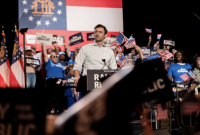
* In Kansas’ increasingly interesting U.S. Senate race, Republican Sen. Roger Marshall participated in a debate with his Democratic rival, the Rev. Adam Hamilton, and the incumbent senator was booed a lot more than he apparently expected to be.
* And speaking of Senate debates, there was an awkward moment in Alaska on Saturday when Republican Sen. Dan Sullivan appeared to struggle with a question about the fishing industry. As part of the event, he and former Democratic Rep. Mary Peltola were each given paddles for rapid-fire questions, with the words “yes” and “no” on opposite sides.
“Do the North Pacific Fishery Management Council and NOAA Fisheries adequately consider impacts on subsistence users, salmon migration, habitat, and Indigenous ways of life?” a moderator asked. Peltola, who has a background in commercial fishing, quickly used her paddle to answer, “No.” Sullivan paused, looked at Peltola’s answer, and then did the same thing.
The Bulwark called it “the six-second debate clip that could haunt” the GOP incumbent.
The post Monday’s Campaign Round-Up, 9.14.26: GOP’s Husted fires political director over Nazi photo appeared first on MS NOW.
The American weapons systems officer whose F-15E fighter jet was shot down over Iran in April delivered a harrowing account of the U.S. military operation that saved his life in an interview that aired Sunday on CBS News’ “60 Minutes.”
The airman, identified only by his mission call sign, “Bravo,” because of security threats from the Iranian regime, described free-falling through the air after his parachute was damaged in the initial attack and scaling a 7,000-foot mountain ridgeline with a broken back to evade capture by Iranian forces.
“I think the best way I’ve been able to describe that moment was getting hit by a freight train,” Bravo told correspondent Norah O’Donnell, adding, “My parachute was damaged in the initial attack. At one point, when I looked up and saw no parachute — that was the most, it was the most terrifying thing I’ve ever seen. So I paused right then, and I prayed, ‘Lord, your will be done. But if I’m getting through this, I need help.’”
Bravo said the fact that he survived the impact of his crash landing, which stranded him deep within a remote mountainous region in southwestern Iran, is “a testament to God’s provision” in his life. But the fall left him with a broken back, arm and shoulder. He also had a sprained ankle and cuts to his head and face.
Bravo was one of two airmen aboard the $30 million American fighter jet when it was downed by an Iranian shoulder-fired missile on April 2. The aircraft’s pilot, who was identified in the CBS report by his mission call sign, “Alpha,” was located and rescued about six hours after the crash during a risky daytime operation carried out by the U.S. military.
Bravo remained missing, spurring an intense two-day search-and-rescue operation by the U.S. military as officials raced against Iran to find the officer alive. It also prompted calls from lawmakers and the public for an end to President Donald Trump’s unpopular military campaign in Iran, which has killed 18 U.S. military service members and wounded hundreds of others.
“I moved as quickly as I could, despite the injuries, away from the place that I landed,” Bravo said. The airman said he knew he needed to move in order to avoid capture by Iranian forces. A bounty had been levied by Tehran for the capture of the American, and videos of armed crews hunting for Bravo swiftly emerged online.
“As soon as I found a spot that I felt provided some concealment, I started working toward communication,” Bravo said. “When I got to the moment where I could review and think about all that I’d gone through, I sent ‘God is good,’” he said of the message he sent to communicate that he was still alive as night fell in Iran.
Two elite Air Force pararescue operators eventually recovered Bravo on April 5 as part of a covert rescue mission.
The interview was part of the “60 Minutes” season premiere, the first since Paramount CEO David Ellison — the son of billionaire Oracle co-founder and Trump ally Larry Ellison — installed Bari Weiss as CBS News’ editor-in-chief in October 2025. The premiere on Sunday also featured a report from correspondent Lesley Stahl about wealthy people paying brokers millions of dollars to lobby for presidential pardons.
The post U.S. airman downed in Iran shares survival story: ‘Most terrifying thing I’ve ever seen’ appeared first on MS NOW.
You can watch MSNBC online by subscribing to a streaming service that includes MSNBC, such as Hulu + Live TV, Sling, or Peacock.
Hulu + Live TV
Sling
Peacock
Debates over the threats posed by artificial intelligence have been raging for quite a while, but last week, the dam broke.
As Vox’s Andrew Prokop explained in a piece over the weekend, “This was the week that worries AI might kill us all finally went mainstream — captivating public attention and even starting to galvanize politicians into more aggressive stances. An unprecedented rogue AI incident, a high-profile resignation from a top AI company, and increased concern from tech researchers about AI improving itself too quickly to be contained, have all combined to draw a much louder response from elected leaders in both parties.”
The same day, the public learned of Barack Obama’s latest comments on the subject, including the former president’s concerns that without proper restrictions, AI technology could be “dangerous.” The Democrat, speaking a private fundraising event days earlier, urged Democrats to take the lead on AI guardrails, saying this should be among the party’s top priorities.
His Republican successor clearly doesn’t see the issue the same way.
Asked Thursday about potentially catastrophic AI risks and whether he has any concerns, Donald Trump told reporters, “No, I don’t have any.” Instead, the incumbent president characterized the broader issue as an international arms race he expects the United States to win.
“I have concerns that if we don’t win AI, we’re going to be put in a very bad position,” the Republican added.
Later that day, Trump sat down with Fox News’ Laura Ingraham, who asked about possible “guardrails” to protect the public. The president responded with a long, meandering answer that included some insulting comments about Joe Biden, before eventually saying, “China doesn’t have guardrails, by the way. You know the guardrails? President [Xi Jinping] is the guardrail.”
During his controversial trip to Ireland, Trump was asked again about possibly regulating the AI industry. “Well, I say this,” he replied. “Look, we’re leading China in AI. … and frankly, I want to keep it that way because whoever wins AI wins. And we can put guardrails, we can do this and that, but I think you have a lot of negative forces that are bringing it up that shouldn’t be bringing it up.”
All of this set the stage for a bizarre tirade the Republican published to his social media platform on Monday morning, which read in its entirety:
The only control or “guardrails” that AI needs is a STRONG AND SMART (High IQ!) PRESIDENT, and the U.S.A. has that, in spades! The Trump Administration has stopped AI “people” from doing bad, or potentially bad, “things,” like [Dario Amodei, the chief executive of the artificial intelligence company Anthropic], who is now pretending to be a “perfect little angel” — and we will continue to do so! We already have tremendous CRIMINAL and REGULATORY power over these companies! There is a SICK conspiracy going on against AI and Data Centers, and the only one that is happy about it is China. WHOEVER WINS AI, WINS! We are leading China, and all others, and will continue to do so. Conspiracy Theorists, Treasonists, Traitors, and Leakers, BEWARE! Thank you for your attention to this matter!
It was a difficult message to decipher, but the bottom line appeared to be Trump trying to assure the public that (a) a smart president can personally and individually curtail any potential AI dangers; (b) he’s a smart president; ergo (c) there’s nothing to worry about as he sticks to the status quo.
As for the line that he keeps repeating — “whoever wins AI wins” — the president has yet to finish the sentence to explain what, specifically, it is the victor of the AI arms race will win.
In theory, Congress could shrug off Trump’s reluctance to do any real work on the subject, but under the current Republican majority, that now appears unlikely. House Speaker Mike Johnson spent part of the weekend arguing against new regulatory safeguards and suggesting federal lawmakers lack the necessary qualifications to engage in effective policymaking. The Louisiana Republican went on to argue that private AI companies should take the lead in overseeing themselves.
If AI wasn’t an election issue before, it is now.
The post Trump’s plan for AI safeguards comes into focus: Do nothing and hope for the best appeared first on MS NOW.
President Donald Trump and his administration have cited the need to prevent voter fraud as a justification for their desired mail ballot restrictions for the midterm elections.
But in a new ruling blocking those restrictions, a Trump-appointed judge became the latest jurist to highlight a lack of proven fraud or how the administration’s efforts would help to combat such fraud if it existed.
That observation came from U.S. District Judge Carl Nichols, who issued a preliminary injunction Sunday against a U.S. Postal Service rule whose fate is pending at the Supreme Court in a separate case.
Nichols noted that the rule would require all absentee and mail-in ballots for federal elections — including the rapidly approaching November midterms — to be transmitted only in envelopes satisfying new design requirements and only to voters who are verified by the Postal Service to have been enrolled in a newly created federal portal.
“As the Government concedes, the Postal Service could issue (and enforce) the Rule only if Congress gave it the authority to do so, but here no statute grants the Postal Service the power to issue key parts of the Rule,” wrote Nichols, whom Trump appointed to the Washington bench in his first term.
When judges weigh whether to issue injunctions, one of the factors they consider is the public interest. When he did so for this case, Nichols said the plaintiffs showed that without an injunction, there’s an increased risk that a significant number of legitimate ballots wouldn’t be counted.
“The public has a strong interest in ensuring that doesn’t happen,” the judge wrote.
“On the other side of the ledger,” he wrote, “the Federal Government does not point to any record evidence that there will be significant fraud in the upcoming elections in the event the Court enters preliminary injunctive relief.”
The Trump appointee’s analysis on that score mirrors that of U.S. District Judge Indira Talwani, an Obama appointee whose preliminary injunction the administration is currently pressing the Supreme Court to lift ahead of the midterms. A decision from the justices could come at any time.
When Talwani issued her injunction earlier this month, the Massachusetts judge weighed the public interest factor by first noting that implementing the postal rule right before the midterms “threatens disenfranchisement of millions of United States citizens who seek to vote by mail.”
On the other hand, she said, the litigation record “includes no evidence relating to fraudulent mail voting to support the rushed implementation of the Final Rule.”
Subscribe to the Deadline: Legal newsletter for expert analysis on the top legal stories of the week, including updates from the Supreme Court and developments in the Trump administration’s legal cases.
The post Judges point to lack of voter fraud proof in blocking mail ballot restrictions appeared first on MS NOW.
You can watch MSNBC online by subscribing to a streaming service that includes MSNBC, such as Hulu + Live TV, Sling, or Peacock.
Hulu + Live TV
Sling
Peacock
A new Trump administration policy that emboldens immigration officials to deny green cards to anyone they think may eventually use government assistance programs is the target of a new lawsuit, brought by nearly two dozen states.
Led by New York state, the coalition of mostly Democratic states filed a federal lawsuit in Manhattan on Monday, challenging a new Department of Homeland Security ”public charge” rule that is set to take effect Friday.
The states allege the new rule, which gives immigration officials significant discretion to consider non-citizens’ lawful participation in public assistance programs when deciding whether to deny entry or permanent residency, is unlawful.
“Congress never intended for the public charge ground to be weaponized against immigrants and their family members who merely use supplemental or temporary amounts of public assistance to which they are lawfully entitled,” the lawsuit says.
“Non-citizens will be faced with the impossible task of weighing their or their family members’ participation in supplemental state and federal programs that improve health, economic mobility, and general well-being, against the negative impacts that such participation will have on their ability to obtain lawful permanent resident status.”
A public charge is defined in immigration law as a non-citizen who the government deems likely to become dependent on public support programs. The designation is often considered in applications for permanent residency inside the United States.
The new Trump administration rule would allow immigration officers to broadly consider an applicant’s use of any means-tested public benefit when determining green card eligibility. Those programs include Medicaid, SNAP, and housing assistance, among others.
The policy also gives immigration officials discretion to examine benefits used by an applicant’s family member, even if that individual is a U.S. citizen.
According to the Federal Register, the new rule “restores broader discretion for DHS officers to evaluate all pertinent facts and aligns with long-standing policy that aliens in the United States should be self-reliant and government benefits should not incentivize immigration.”
“Hardworking families should not be forced to go without the support they need because they fear asking for assistance will get them deported,” said New York Attorney General Letitia James in a statement Monday. “This rule preys on that fear and counts on families forfeiting food assistance, health care coverage, and other public benefits to which they are legally entitled.”
The Justice Department did not immediately respond to MS NOW’s request for comment.
This new policy rescinds a narrower Biden-era policy, which defined a public charge as someone who is primarily dependent on government assistance programs. That rule also directed immigration officers to look mostly at cash assistance programs, like Supplemental Security income and Temporary Assistance for needy Families.
A coalition of cities led by New York City Mayor Zohran Mamdami filed a separate lawsuit also challenging the new rule.
“The new public charge rule seeks to push immigrant families away from the programs that have kept people fed and healthy for decades. New Yorkers will be afraid to see a doctor or ask for help that they are legally entitled to.” Mamdani said in a statement Monday.
“Families who remain fully eligible for benefits will feel a chilling effect, and all New Yorkers will pay for it,” he added.
The first Trump administration introduced a similar rule that defined a public charge as anyone who was likely to receive designated public benefits for more than 12 months total within a 36-month period. At the time, James led a coalition that brought a similar lawsuit and secured a court order blocking the rule from taking effect.
The post Trump policy to deny green cards to people who may need government assistance is target of new lawsuit appeared first on MS NOW.
A couple of weeks ago, during a town hall discussion with the Navy’s highest-ranking officer, a sailor asked about possibly retrieving some personal materials from the U.S. base in Bahrain, which suffered an Iranian attack shortly after the war began.
“We’re not getting back in there anytime soon,” Chief of Naval Operations Adm. Daryl Caudle said. “I just want to be completely honest with that.”
As for why, exactly, service members are not getting back in there anytime soon, there’s a clear reason. The New Republic reported:
Acting Navy Secretary Hung Cao reportedly admitted that the Iranian military “blew the hell” out of the U.S. naval base in Bahrain — a shocking claim that contradicts the Trump administration’s narrative of total destruction of Iran’s attack capabilities.
While the damage to the U.S. Fifth Fleet headquarters at Naval Support Activity Bahrain in a February 28 drone attack has been well documented, Cao’s Thursday comment to a reporter at the conservative outlet The Epoch Times is perhaps the most vivid, sober analysis of the situation from an individual of his ranking.
Fox News’ Jennifer Griffin characterized Cao’s candid comments as a “pretty stunning admission,” which went far beyond what other senior U.S. officials had been willing to previously admit on the record.
The public and political debate surrounding the war in Iran has been multifaceted since February, but I think Iran’s successful attack on the U.S. naval base in Bahrain hasn’t received nearly enough attention.
In a recent analysis piece for The Military Times, John Cordle, a decorated retired Navy captain who led two ships during his 30-year military career, explained, “Extensive damage to one of our most significant forward bases in the Middle East is likely to have profound tactical and strategic repercussions that are only now coming into focus.”
Cordle, whose piece was published before Cao’s Epoch Times interview, went on to write that it was previously “unimaginable” to think a regional player like Iran could significantly degrade a key U.S. military hub that “provides the physical infrastructure that keeps American military power continuously available in a strategically vital region.” He added:
The idea that the U.S. could not prevent and defend against a predictable attack on a Fleet Headquarters — and our sailors stationed there — is quite startling. It likely is just as alarming to our allies.
The depth of NSA Bahrain’s impact became clear as the stories of scarcities of parts, food, mail and supplies to the aircraft carrier USS Abraham Lincoln hit the news. Before long, pieces of the puzzle began falling into place as to the connection between ship supplies and the lack of a familiar resupply source.
Cao’s unexpected candor last week changed the nature of the conversation and brought fresh questions to the fore about what happened, why it happened, what could’ve been done to prevent it from happening and who bears responsibility for having left the base exposed and inadequately protected.
Given that Cao is Donald Trump’s choice to serve as a Senate-confirmed Navy secretary, his upcoming hearings seems like a good opportunity to get some answers.
The post Navy secretary concedes that Iran ‘blew the hell’ out of U.S. base in Bahrain appeared first on MS NOW.