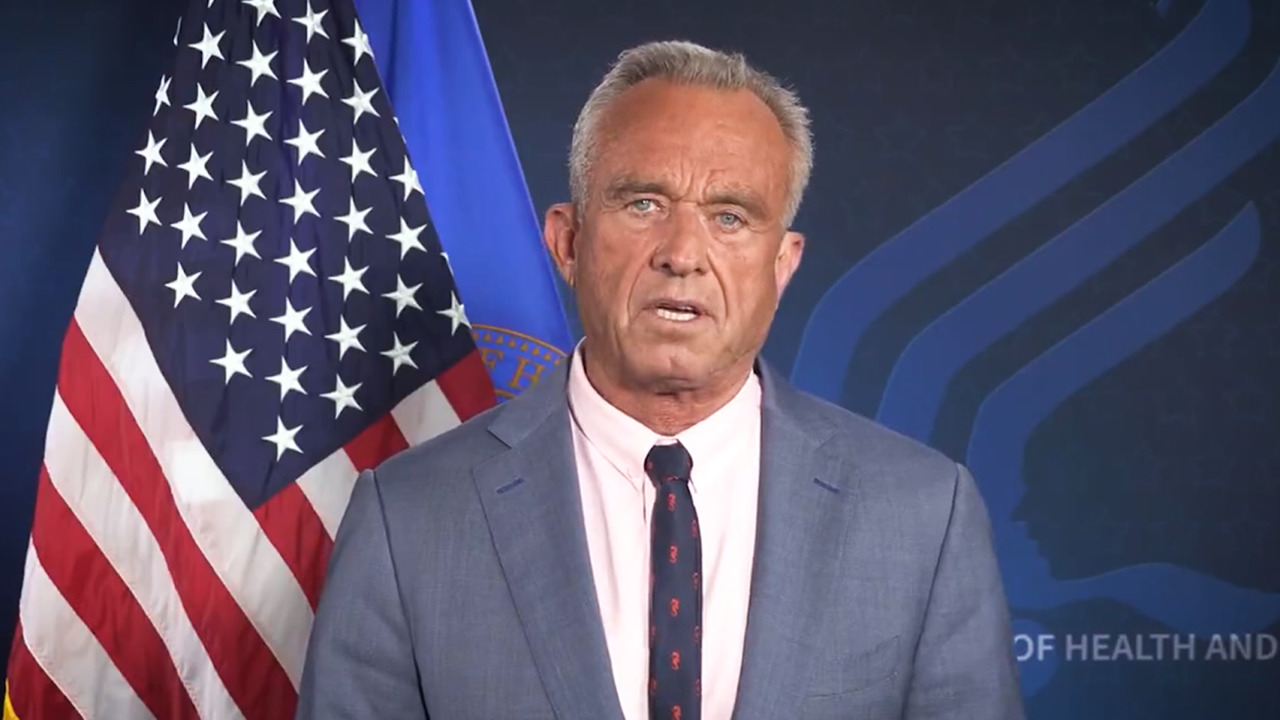
‘Painful period’: RFK Jr. lays off 10,000 HHS employees
 lead image

You can watch MSNOW online by subscribing to a streaming service that includes MSNOW, such as Hulu + Live TV, Sling, or Peacock.
ou can watch MS NOW (formerly MSNBC) on your existing cable provider using the exact same channel number you used for MSNBC.
MS NOW kept its channel positions during its rebrand. Check your local channel guide or your provider’s online channel finder for: [1]
Live TV Streaming ServicesIf you do not have traditional cable, you can stream MS NOW live using paid TV services like Sling TV, Hulu + Live TV, or YouTube TV. You can also watch MSNOW on YouTube TV


CHICAGO — A progressive social media influencer announced a run for Congress on Monday in the Chicago-area district held by Democratic Rep. Jan Schakowsky, citing frustration with Democratic Party leadership.
“I don’t think the Democratic Party right now is doing enough. [Sen.] Chuck Schumer backing down on the funding bill was just disgusting, frankly, and we can’t keep going that way,” Kat Abughazaleh, who announced her run on the Bluesky social network, said in an interview.
Schakowsky, a member of the Congressional Progressive Caucus, has represented the area for decades. The Illinois Democrat, who is 80, has yet to announce whether she’ll seek reelection.
Abughazaleh covered the Democratic National Convention as a social media influencer and before that worked at the liberal watchdog group Media Matters For America.
She gained fame on TikTok for her biting political humor, and her videos were published by the liberal magazine Mother Jones, where she critiqued Fox News for how it covered then-Vice President Kamala Harris’ presidential run.
Abughazaleh’s move into Illinois politics comes amid widespread frustration with the party among progressive Democrats. Sen. Bernie Sanders (I-Vt.) has recently encouraged progressives to run as independent candidates and ditch the unpopular Democratic label.
Abughazaleh moved to the Chicago area in July but voted in the 2024 election in Washington, D.C., because her lease wasn’t yet up, she told POLITICO. She said she registered to vote in Illinois last month and currently lives outside the district but plans to move into the district “soon.”
“The district itself is really, really, really cool, and I think that it deserves more options for representation,” Abughazaleh told POLITICO. “Since 1998, there hasn’t been a competitive primary. I was born in 1999. So I think a huge problem with why we’re in this mess — with rising fascism, with ineffective Democrats — is just because we aren’t giving voters more options. There’s not enough diversity of thoughts or how we can change the establishment.”
Schakowsky recently said that she’s mulling her next move, saying she’s still “ready to fight” but acknowledges age is a factor in her deliberations.
“Take out the word progressive, and let’s talk about what we mean,” Schakowsky said. “We talk about it as if you have to be a progressive to be for these kinds of things that help people. We have to be better at talking about them.”
Schakowsky was first elected to the 9th Congressional District in 1998, after serving eight years in the Illinois General Assembly. In her primary that year, she defeated then-businessperson JB Pritzker, who went on to become the state’s governor in 2019.
Should Schakowsky not seek reelection, a number of notable Illinois Democrats would likely be interested in the seat, including state Sen. Laura Fine and Evanston Mayor Daniel Biss, who both represent constituents in the district.
Former U.S. Rep. Mia Love of Utah, a daughter of Haitian immigrants who became the first Black Republican woman elected to Congress, died Sunday.
She was 49.
Love’s family posted news of her death on Love’s X account.
She had undergone recent treatment for brain cancer and received immunotherapy as part of a clinical trial at Duke University’s brain tumor center. Her daughter said earlier this month that the former lawmaker was no longer responding to treatment.
Love died at her home in Saratoga Springs, Utah, according to a statement posted by the family.
“With grateful hearts filled to overflowing for the profound influence of Mia on our lives, we want you to know that she passed away peacefully,” her family said. “We are thankful for the many good wishes, prayers and condolences.”
Utah Gov. Spencer Cox referred to Love as a “true friend” and said her legacy of service inspired all who knew her.
Love entered politics in 2003 after winning a seat on the city council in Saratoga Springs, a growing community about 30 miles (48 kilometers) south of Salt Lake City. She later became the city’s mayor.
In 2012, Love narrowly lost a bid for the House against the Democratic incumbent, former Rep. Jim Matheson, in a district that covers a string of Salt Lake City suburbs. She ran again two years later and defeated first-time candidate Doug Owens by about 7,500 votes.
Love didn’t emphasize her race during her campaigns, but she acknowledged the significance of her election after her 2014 victory. She said her win defied naysayers who had suggested that a Black, Republican, Mormon woman couldn’t win a congressional seat in overwhelmingly white Utah.
She was briefly considered a rising star within the GOP and she kept her distance from Donald Trump, who was unpopular with many Utah voters, while he was running for president ahead of the 2016 election.
In an op-ed published earlier this month in the Deseret News, Love described the version of America she grew up loving and shared her enduring wish for the nation to become less divisive. She thanked her medical team and every person who had prayed for her.
Love said her parents immigrated to the U.S. with $10 in their pocket and a belief that hard work would lead to success. She said she was raised to believe passionately in the American dream and “to love this country, warts and all.” America at its roots is respectful, resilient, giving and grounded in gritty determination, she said.
Her career in politics exposed Love to America’s ugly side, but she said it also gave her a front row seat to be inspired by people’s hope and courage. She shared her wish for neighbors to come together and focus on their similarities rather than their differences.
“Some have forgotten the math of America — whenever you divide you diminish,” Love wrote.
She urged elected officials to lead with compassion and communicate honestly with their constituents.
“In the end, I hope that my life will have mattered and made a difference for the nation I love and the family and friends I adore,” Love wrote. “I hope you will see the America I know in the years ahead, that you will hear my words in the whisper of the wind of freedom and feel my presence in the flame of the enduring principles of liberty. My living wish and fervent prayer for you and for this nation is that the America I have known is the America you fight to preserve.”
In 2016, facing reelection and following the release of a 2005 recording in which Trump made lewd comments about groping women, Love skipped the Republican National Convention and released a statement saying definitively that she would not vote for Trump. She instead endorsed Texas Sen. Ted Cruz in the GOP race, but he dropped out months later.
While seeking a third term in 2018, Love tried to separate herself from Trump on trade and immigration while still backing her party’s positions on tax cuts. Despite Republican voters outnumbering Democrats by a nearly three-to-one margin in her district, though, she lost by fewer than 700 votes to Democrat Ben McAdams, a former mayor of Salt Lake City.
Trump called out Love by name in a news conference the morning after she lost, where he also bashed other Republicans who didn’t fully embrace him.
“Mia Love gave me no love, and she lost,” Trump said. “Too bad. Sorry about that, Mia.”
After her loss, Love served as a political commentator on CNN and as a fellow at the University of Sydney.
Following Trump’s election in November, Love said she was “OK with the outcome.”
“Yes, Trump says a lot of inconsiderate things that are unfortunate and impossible to defend,” Love wrote in a social media post. “However, his policies have a high probability of benefiting all Americans.”
Attorney General Pam Bondi warned Rep. Jasmine Crockett (D-Texas) on Sunday to “tread very carefully” following the lawmaker’s recent remarks voicing support for Elon Musk to be “taken down.”
“She is an elected public official, so she needs to tread very carefully because nothing will happen to Elon Musk, and we’re going to fight to protect all of the Tesla owners throughout this country,” Bondi said during an appearance on Fox’s “Sunday Morning Futures.”
The warning comes days after the Democrat spoke at a virtual rally held for the The Tesla Takedown movement, a group rallying against Musk and his Department of Government Efficiency’s efforts to bulldoze the federal bureaucracy through boycotts and demonstrations at Tesla properties. The coalition is organizing 500 demonstrations March 29 at Tesla locations across the country.
“On March 29, it’s my birthday, and all I want to see happen on my birthday is for Elon to be taken down,” Crockett said during her remarks. “I have learned, as I serve on the DOGE Oversight committee, that there is only one language that the people that are in charge understand right now, and that language is money.”
Crockett clarified during the rally that her calls for action were nonviolent.
U.S. Tesla locations have been the target of widespread protests — and at times, vandalism — over the last few weeks due to Musk’s involvement with the Trump administration. Bondi’s caution also follows her recent announcement that the Department of Justice is charging three people for allegedly vandalizing Tesla cars and properties, which she has referred to as “domestic terrorism.”
Before calling out Crockett, Bondi also doubled down on her determination to rein in the protests.
“We are not coming off these charges,” she said. “We are looking at everything, especially if this is a concerted effort.”
The pervasive fear and anger that have been rippling through federal agencies over Elon Musk’s slashing approach to shrinking government deepened even further on Friday over the billionaire tech mogul’s threat to root out and punish anyone who is leaking to the media.
They’ve already taken every precaution they can for fear of retaliation: setting Signal messages to automatically disappear, taking photos of documents they share instead of screenshotting, using non-government devices to communicate. But disclosing the chaos caused by Musk’s Department of Government Efficiency, for many, outweighs the risks that come with leaking.
Following Thursday’s New York Times report that Musk was set to receive a Pentagon briefing about a confidential contingency plan for a war with China, the Tesla and SpaceX CEO posted on his social media platform X that leakers “will be found” and, he intimated, punished.
“I look forward to the prosecutions of those at the Pentagon who are leaking maliciously false information to NYT,” Musk wrote in his post.
But Musk’s post is not having the chilling effect on leakers he’d intended, according to conversations with more than half a dozen government employees who had previously spoken to POLITICO. If anything, it might be the other way around.
“We are public servants, not Elon’s servants,” said one Food and Drug Administration employee who, like all people interviewed for this story, was granted anonymity to speak candidly about internal dynamics. “The public deserves to know how dysfunctional, destructive, and deceptive all of this has been and continues to be.”
“Leakers are patriots,” said one Agriculture Department employee. Helping the media report on problems or concerns inside agencies, the USDA employee added, is motivated by a desire for greater transparency — the same goal Musk has said undergirds his own work through DOGE.
“If the Biden administration or Obama had acted like this, no one would have tolerated it,” the staffer said. “The Trump administration doesn’t get a pass.”
Musk’s comments may not have caused a major shift in how federal workers view sharing information with reporters, one federal employee at a health agency said, citing group chats with other employees.
But even before Musk’s comments this week, the prevailing atmosphere inside many federal agencies — from constant threats of firing and being labeled enemies of the public to ousting them for following orders from previous administrations — have left employees feeling vulnerable, increasingly incensed and concerned about their physical safety.
Those safety concerns include law enforcement going after leakers to far-right extremists attacking people who make up the federal workforce.
Many federal government employees who have spoken with POLITICO over the past eight weeks said they have never previously been in contact with journalists. And if not for Musk’s “move fast and break things” approach to reducing staff and accessing sensitive government data, that would likely still be the case for nearly all of them.
“He IS A LEAKER,” one senior Federal Aviation Administration official said of Musk in a Signal message. “When you put hard drives on data systems at government agencies you are creating the biggest security breaches we have seen in years and years. Possibly ever.”
At the same time, even federal workers who haven’t spoken to media outlets are terrified of being suspected or accused of leaking information to journalists.
By now, staffers across federal agencies are also worried that they’re being surreptitiously watched — either through software installed on company devices or cameras in offices. It’s unclear whether these claims are legitimate, but they have caused deep anxiety among employees even before the latest threat from Musk.
“We’re taking more conversations in-person, out of the office completely. Putting phones on airplane mode or going to the basement,” said a staffer at the National Institutes of Health. “I don’t take my phone when I’m talking to coworkers anymore. I assume there are cameras and listening devices everywhere.”
And many will only talk with reporters using Signal or similar messaging apps that offer end-to-end encryption to prevent third parties from tapping into conversations. “If someone refuses to get on an app like Signal and also doesn’t talk [in person], I immediately don’t trust them,” the NIH staffer said.
Adding to the unease is knowing how Musk has previously encoded internal messages at his electric car company Tesla with distinct informationlike “one or two spaces between sentences” to identify leakers. He could, some fear, go even further and seed parts of their agency with easily traceable falsehoods.
“I’m much more heavily vetting the things I hear before talking to the media,” the NIH staffer said. “Everything Musk is saying is saber-rattling trying to silence government employees from talking to the media. And unfortunately, it’s working.”
Musk is not the first senior member of the Trump administration to threaten to clamp down on leaks to the press.
In a post on X last week, Director of National Intelligence Tulsi Gabbard pledged to “aggressively” pursue what she said were unauthorized disclosures to the media from officials working in the nation’s spy agencies.
“Politically motivated leaks undermine our national security and the trust of the American people, and will not be tolerated,” said Gabbard, who as a member of Congress expressed sympathy for former National Security Agency contractor Edward Snowden, who shared reams of classified information with the press.
Gabbard listed several examples of what she claimed were unauthorized leaks to the media, citing a number of outlets by name including the Washington Post and NBC.
In a press release last week, the Office of the Director of National Intelligence stated that Gabbard had established a whistleblower hotline directly to her office for intelligence officials looking to report concerns about potentially unauthorized activity by their colleagues.
One staffer at a Department of Homeland Security agency said that most employees speaking to the media agree about the importance of not disclosing information that could compromise national security, even as they exercise their First Amendment right to disclose less sensitive information they think is important for the public to know.
“Ensuring freedom of speech and freedom of the press are vital to maintaining transparency and accountability in the current climate of instability being fostered by this administration,” the DHS agency official said. “Expressing concerns is part of OUR right to speak openly. It’s vital that any administration creates an environment where employees feel heard, respected and empowered to contribute constructively, rather than be silenced and ridiculed.”
Lauren Gardner, Marcia Brown and Maggie Miller contributed to this report.
Elon Musk has again publicly threatened people who leaked information on his sweeping power across the Trump administration. How he’s handled leaks at his companies could be a sign of what’s next for the federal government.
“I look forward to the prosecutions of those at the Pentagon who are leaking maliciously false information to NYT,” Musk wrote hours after The New York Times reported that Pentagon officials were expected to brief the top adviser to President Donald Trump on U.S.-China tensions, including potential war planning. “They will be found.” (POLITICO has reported that the Pentagon briefing will focus on the threats China poses, but won’t include any classified war plans. It was not clear if that was the initial plan.)
Musk’s statement, posted on his social media site X, echos his playbook of berating and pursuing recourse against leakers to snuff out internal sabotage at the tech billionaire’s companies, like the electric vehicle company Tesla, space exploration and defense contractor SpaceX, and X.
These moments indicate how he may move forward with leakers in the federal government.
Here’s how he’s cracked down on leaks.
Leaks aren’t always so easy to handle when you can’t identify the leaker.
After Musk bought the company, Twitter’s source code was leaked online and posted on GitHub, a website where software developers can share project codes. It was unclear then who leaked the code.
So in March 2023, the social media site issued a copyright infringement notice against GitHub, which removed the information.
At the time, though, Twitter could not identify the person who leaked the code and sought to subpoena information both on the poster and “for the users who posted, uploaded, downloaded or modified the data” related to the source code leak.
Months later, Twitter leadership, including its CEO Linda Yaccarino, announced she wanted to stamp out leaks — and asked employees to help find any leakers in their midst.
“If you suspect any employee is not protecting Twitter’s confidential information, please report it by submitting a ticket,” read an internal email shared publicly by a then-executive. “If you need guidance or want to schedule training for your team, please email insiderthreat@twitter.com.”
When Musk wants to find a leaker, he might set a canary trap.
In 2022, Musk revealed on X how he ensnared a Tesla worker who had leaked the company’s private information to the press over a decade ago: The company sent “what appeared to be identical emails to all, but each was actually coded with either one or two spaces between sentences.”
The emails, which he contended were his brainchild, effectively created a fingerprint for every recipient that could be traced if the messages were sent to or published by the press.
Using metadata or unique markers to identify leakers is not unusual. The federal government in 2017 said it relied, in part, on noting that documents obtained by The Intercept were “folded and/or creased” to determine which employee leaked it, and printed documents can have unique identifiers on them.
People have since found ways around these traps to leak information to the press securely. Some have taken photos of internal communications on other devices. Or they’ve turned to encrypted messaging platforms like Signal to chat with reporters.
When a former Tesla worker allegedly stole confidential information, merged it with falsehoods and leaked it to the media, the company swiftly filed a lawsuit against them in 2018. The lawsuit claimed Tesla employees had already identified the hacker by the time the complaint was filed through an internal investigation in which the man confessed he wrote software that transferred heaps of data externally.
But Musk has realized the mere threat of a lawsuit is an equally powerful tool to silence many testy employees.
Musk’s Tesla warned staffers in 2019 that if they leaked information, they could be sued by the company, which had filed a couple lawsuits against employees who allegedly took company information to competitors, CNBC reported at the time.
And in December 2022, months after the Twitter source code leak, the company said in an internal email that “if you clearly and deliberately violate the NDA that you signed when you joined, you accept liability to the full extent of the law & Twitter will immediately seek damages,” according to an email tech journalist Zoe Schiffer obtained.
Staff at Musk’s companies have largely been tight-lipped in recent years, particularly after he hired people loyal to the companies’ missions and himself. Now, it is possible the same blueprint could come into play in the federal government, months after the Trump administration seeded some federal agencies with the tech billionaire’s acolytes.
Every week political cartoonists throughout the country and across the political spectrum apply their ink-stained skills to capture the foibles, memes, hypocrisies and other head-slapping events in the world of politics. The fruits of these labors are hundreds of cartoons that entertain and enrage readers of all political stripes. Here’s an offering of the best of this week’s crop, picked fresh off the Toonosphere. Edited by Matt Wuerker.