Posted on Leave a comment

Top Republicans didn’t expect Trump’s dividends. Now they’re scrambling.

090926 shm06440 rncdayone 80.JPG

DALLAS — Top Republican lawmakers had no idea President Donald Trump was going to promise $5,000 checks to every adult American so long as his party keeps control of Congress. Now, they’re grappling with how to handle the fallout.

GOP leaders have privately pushed back on similar Trump promises of giving money to Americans in the past year, according to four people granted anonymity to share details of closed-door meetings. Senior Republicans on Capitol Hill were blindsided by Trump’s Wednesday night announcement in Dallas, and are trying to manage lawmakers’ and voters’ expectations about a trillion-dollar-plus proposal they cannot deliver.

“The only thing that I knew of was that he has this concept of a dividend of all Americans being able to share in the success of America,” House Majority Whip Tom Emmer, who appeared supportive of the idea, said in an interview on the sidelines of the party’s midterm convention. “But last night, no, I was just like you and everybody else when I went, ‘Oh, that’s interesting. Okay.’”

NRCC Chair Richard Hudson added in an interview: “First, I’d heard of it, so I want to talk to him and get some details before I comment.” Hudson said the idea was “exciting,” but he didn’t indicate the House GOP campaign arm would start touting the idea in ads for battleground candidates.

As for the chances of the measure passing Congress, Hudson responded: “Not this Congress. Because Democrats in the Senate will never go through with it.”

Republican leaders, indeed, don’t have the votes to pass such an offer this year, with some in the party questioning the legality of Trump effectively declaring he would pay for votes. GOP fiscal hawks and others also quickly shot it down.

And some Republicans worry Trump’s last-ditch move steps on their carefully laid messaging about the economic benefits of their major tax cuts package — benefits which have largely been erased by the Iran war and tariffs, according to five senior Republicans, who were also granted anonymity to speak candidly.

“It seems incredibly desperate,” said one of the House Republicans.

“I see zero chance of this happening,” said another House Republican at the convention.

The scramble to figure out their position — and how serious Trump is — comes at a critical final stretch of the midterms and as many voters grow increasingly skeptical of the GOP’s record on the economy.

Democrats were quick to slam Trump’s announcement as a way to bribe Americans and distract from an unpopular trade agenda and war in the Middle East. And as Republicans gathered in Dallas for their splashy midterm convention, the emerging splits over the dividends were on full display.

GOP lawmakers have privately noted a clear divide in the messaging around Trump’s promise of $5,000 checks: The White House and Trump’s campaign social media accounts are wholeheartedly touting the idea. GOP House and Senate campaign arms, meanwhile, are not. The NRSC declined to comment on the proposal.

Vice President JD Vance defended Trump’s offer on Fox News shortly after the president announced it Wednesday night, saying it was intended to boost “the American middle class.” But Vance did not mention the Trump proposal during a closed-door breakfast with GOP lawmakers, state party officials and activists from key battleground states on Thursday morning, instead touting a string of GOP economic achievements like Trump’s executive action that aims to lower prescription drug costs and the GOP tax cuts package.

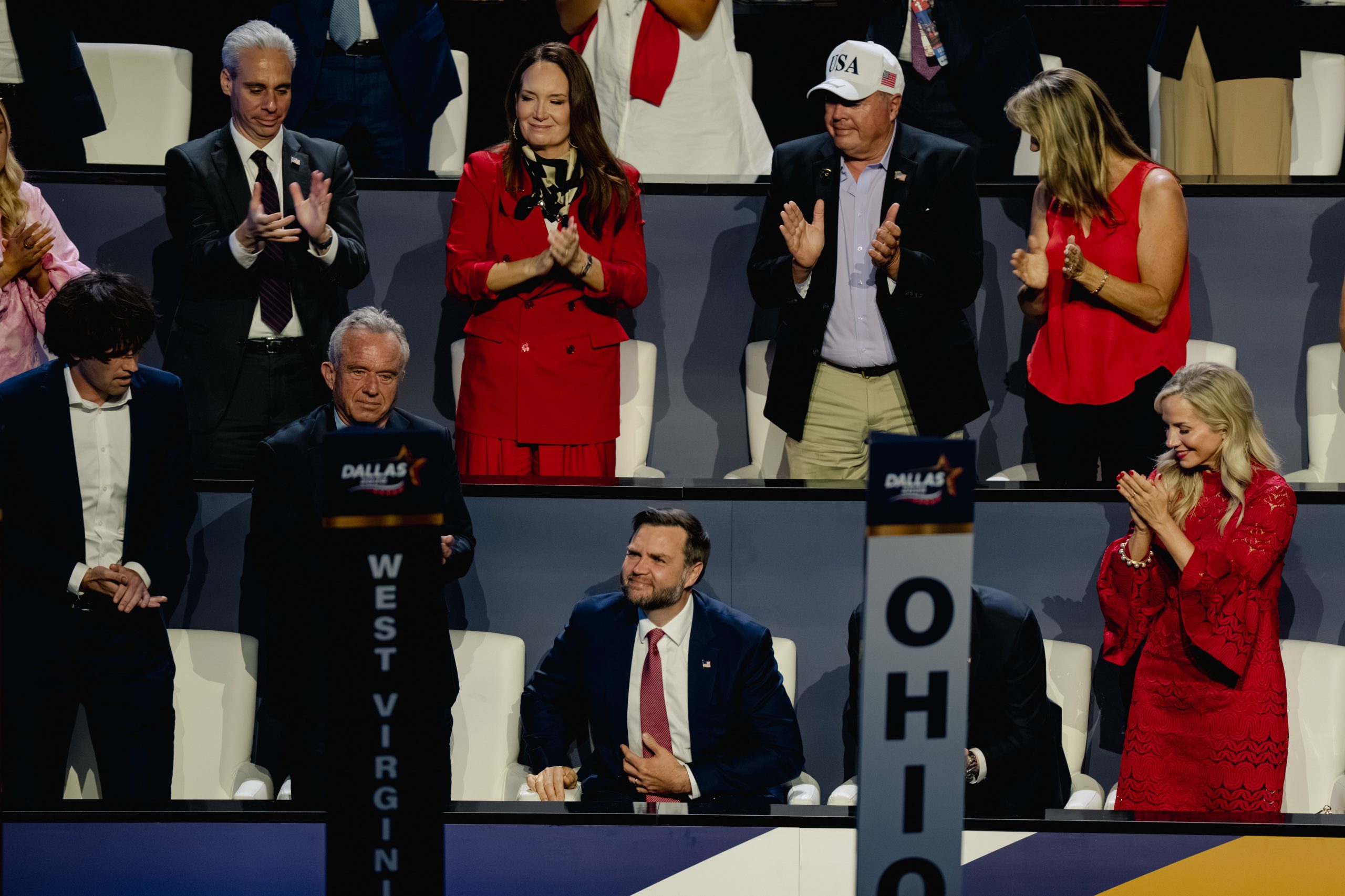
The crowd acknowledges Vice President JD Vance on night one of the Republican Midterm Convention at the American Airlines Center in Dallas on Sept. 9.

“I think we’re all looking forward to learning more,” said Rep. Bryan Steil (R-Wis.) as he left the closed-door breakfast with Vance.

Asked if he would support Trump’s proposal, Steil repeated, “I think we’re all looking forward to learning more.”

While Republicans scramble to figure out how to position themselves on the “dividend” pledge, Trump told CBS on Thursday he doesn’t think he needs Congress to approve his plan to send out payments.

Amy Natoce, a spokesperson for Ohio GOP Sen. Jon Husted, who faces a tough battle for reelection this fall, said his team “has reached out to the White House to learn more about the proposal and how it would work.” Natoce noted that “putting money directly back into the pockets of hardworking Ohioans is in line with Jon Husted’s priorities.”

Some Republicans were willing to more fully embrace the idea.

Texas Sen. Ted Cruz said Wednesday that it was “an incentive for work” — even though the money will go to all Americans regardless of employment status. Ohio Sen. Bernie Moreno pledged to draft up a bill on the checks “so that we can get the Trump Dividend passed immediately after the November 3rd election.” Kansas Sen. Roger Marshall, who’s facing a surprisingly competitive race, eagerly asked his social media followers to “comment how you will spend your $5,000 Trump Dividend when Republicans win in November.”

Sen. Ted Cruz (R-Texas) is pictured on the first day of the Republicans' midterm convention at the American Airlines Center in Dallas on Sept. 9.

Fiscal hawks say they are eager for information. Rep. Glenn Grothman (R-Wis.), who serves on the House Budget Committee, declined to say whether he would support the president’s proposal which could cost more than $1 trillion.

“I would like to know how they would plan to pay for … back of envelope … well over $1 trillion,” Rep. Chip Roy (R-Texas) said in an interview Wednesday night shortly after Trump announced the proposal.

Trump has promised a litany of dividends and checks to Americans in recent years that have never materialized.

He raised the idea of direct checks to Americans in private meetings with GOP leaders before, often with money he says are from tariffs or the DOGE cuts. It’s an idea that Trump and some close White House advisers have discussed on and off for extended periods of time, particularly during his second term.

Each time, GOP leaders on Capitol Hill have argued that such an idea wouldn’t have the votes among Republicans given the price tag — and that it would likely require Congress to codify Trump’s controversial tariffs into law.

In December, Trump sent a $1,776 check to all members of the military, a move he referred back to while unveiling the dividend plan Wednesday. And he quickly followed up on Thursday with a separate offer to send money to Americans: $500 rebate checks to about 1 million Obamacare enrollees in 30 states.

Democrats immediately pounced on the latest proposal, including several candidates locked in competitive November races.

“Is this some kind of sick joke? Donald Trump’s policies are costing us more than [$5,000] — from his illegal war in Iran and his trade wars — and this dividend is nothing but a lie that wouldn’t even begin to make up for what he’s costing us,” Michigan Democratic Senate candidate Abdul El-Sayed said in a statement to POLITICO.

A spokesperson for El-Sayed’s opponent, Mike Rogers, did not respond to a request for comment on the proposal. He also declined questions from reporters at the Dallas convention Thursday.

So far Democratic leaders have been dismissive of the idea.

Senate Minority Leader Chuck Schumer called the dividends a “bribe” to Americans and said they demonstrate Trump’s weak political position.

“Trump just talks out of who knows what,” he told reporters Thursday in New York City.

The Democratic Congressional Campaign Committee and House Majority PAC did not indicate that they planned to include the dividends in messaging to voters.

House Majority Whip Rep. Tom Emmer (R-Minn.) speaks on stage on the first day of the 2026 midterm convention at the American Airlines Center on Sept. 9 in Dallas.

Emmer dismissed the criticism that the checks were a bribe, saying Trump wanted Americans “to share in the success” of the country.

He acknowledged it’s unlikely the House takes up such a bill before the midterms, given there is no proposal drafted yet and only one week of session scheduled before November, but expressed confidence the GOP could deliver on Trump’s promise after the election.

“Let the policy guys draft it. Let them debate it. Let them move it through committee,” Emmer said. “You get it to the whip’s office. We’ll pass it.”

This post was originally published on this site

Posted on Leave a comment

Kamala Harris to campaign with Ossoff in Georgia

Kamala Harris will campaign with Sen. Jon Ossoff in Georgia and headline a fundraising dinner hosted by Fulton County Democrats next month, marking her latest involvement in the midterm elections.

Harris is also slated to join Nevada attorney general and gubernatorial candidate Aaron Ford next month in Las Vegas and campaign with Democratic challengers in two competitive House races in her home state.

“It is critical for Democrats to win this November so we can fight the Trump administration’s corruption and work to lower costs for the American people,” a Harris spokesperson said in a statement. “Vice President Harris will continue to do whatever is needed to support candidates in races where she can be helpful.”

The events in Georgia were first reported by CNN. Harris will also be the keynote speaker at the fundraising dinner on Oct. 30 in Atlanta. An Ossoff campaign spokesperson confirmed his plan to campaign with Harris. Ossoff’s campaign previously told POLITICO that it would welcome Harris to Georgia to stump with or on behalf of the senator.

Still, the announcements come as some Democrats have been keeping distance from the party’s last presidential nominee.

In Iowa, where Democrats are hoping to flip a Senate seat and retake the governor’s mansion in a state where Harris lost by 13 points in 2024, the two candidates both declined to have Harris’ help. So did Mary Peltola, the Democratic Senate candidate in Alaska who “isn’t seeking endorsements from anyone from the Lower 48,” and House candidates in some red states and rural districts.

For her part, Harris has skirted the question of whether she will run again in 2028 and said she is focusing on the midterm elections.

“Right now midterms [are] full-time occupying my thoughts, my mind and my work,” Harris said in a recent podcast episode with Megan Rapinoe on Vox Media. “I’m spending full time working on doing everything I can to help people restore some balance in our government, which is through the midterms, winning back Congress, the House and the Senate.”

“I haven’t decided. But honestly, from my perspective, ’28 doesn’t matter if we don’t win ’26,” she said to a question on another presidential bid.

Alec Hernández contributed to this report.

This post was originally published on this site

Posted on Leave a comment

Why so many incumbents lost primaries this year

It’s been a bad year to be an incumbent.

Rhode Island Gov. Dan McKee’s ouster on Wednesday, the first primary defeat for an incumbent governor in eight years, caps off a primary season that’s seen longtime leaders fall across the map and politicians across both parties struggle to make the leap to higher office.

Thirteen members of Congress have lost their reelection bids: seven Democrats and six Republicans, including two GOP senators. At least 16 more who were trying to move from the House to the Senate or take on statewide office have lost primaries: nine Republicans and seven Democrats, including Colorado Sen. Michael Bennet who unsuccessfully ran for governor.

The upheaval has been driven by a confluence of factors that will continue to dog incumbents through November. Voters are frustrated with both parties’ leadership in Washington. President Donald Trump has targeted some GOP foes as he looks to cement his legacy; Democrats are in the midst of pitched generational and ideological battles. Some members in both parties faced daunting new district lines. Others faced scandals that sank them.

In some races, those factors converged. Rep. Haley Stevens (D-Mich.) didn’t benefit much from her years in Washington in her Senate bid — and lost her primary to a left-flank rival who yoked her to the party establishment.

Caitlin Legacki, who advised Stevens’ bid, said incumbents’ losses this year show voters are simply fed up.

“It speaks to the high level of dissatisfaction that voters have with everyone,” said Legacki, who noted the anti-incumbent climate contributed to Stevens’ loss. “It’s a major ‘throw the bums out’ moment.”

DEMS KICK INCUMBENTS TO THE CURB

Democrats disillusioned with their leadership in Washington are taking it out on the party’s rank and file.

Progressives picked off more-moderate House members from New York to Colorado. Younger challengers ousted older incumbents from Texas to Connecticut. Local elected officials outran Washington incumbents. And voters have spurned lawmakers seeking higher office from Michigan to Minnesota.

Sometimes age was the biggest factor, sometimes it was ideology and sometimes both played a role. Democratic socialists defeated decades-older Reps. Diana DeGette of Colorado and Rep. Adriano Espaillat of New York. Former Hartford Mayor Luke Bronin relied on generational change to topple longtime Rep. John Larson in Connecticut.

THE TRUMP FACTOR

For Republicans, Trump played a major role in directing voters against his longstanding Washington foes.

Trump-backed challengers wiped MAGA irritants Sen. Bill Cassidy (R-Louisiana) and Rep. Thomas Massie (R-Ky.) off the map. And the president’s late-stage endorsement of Texas Attorney General Ken Paxton in the Senate runoff helped sink Sen. John Cornyn (R-Texas).

REDISTRICTING RIPPLE EFFECTS

The unusual mid-decade gerrymandering war took out members of both parties, who lost competitive races in less favorable districts, ran for other offices or switched parties to avoid similar fates.

Texas Democratic Rep. Al Green was ousted by Rep. Christian Menefee in a member-on-member primary forced by gerrymandering that played on their generational divide.

Democratic Rep. Julie Johnson lost her redrawn Dallas-area district to former Rep. Colin Allred, while Rep. Dan Crenshaw’s right-flank challenger leveraged the redraw (as well as some of Crenshaw’s breaks with Trump) to oust the Republican.

Others chose to retire rather than keep fighting uphill battles. Democratic Reps. Steve Cohen of Tennessee (who had already been facing a generational primary challenge before the redraw), Lloyd Doggett of Texas and Cleo Fields of Louisiana hung it up after Republicans dismantled their districts. So did GOP Reps. Darrell Issa of California and Burgess Owens of Utah after their districts were redrawn. California Rep. Kevin Kiley, who opposed the mid-decade gerrymanders and switched from GOP to independent after his district was redrawn, said the new maps have unleashed “chaos” on the House and “reduced the quality of representation in Congress.”

SWEPT OUT BY SCANDAL

Call it the midterms of controversy: Incumbents in both parties have succumbed to the political pressures of their scandals this year.

Democratic Rep. Eric Swalwell ended his run for California governor and exited Congress amid sexual assault and misconduct allegations. Rep. Tony Gonzales (R-Texas) dropped his reelection bid and resigned after admitting to having an affair with a staffer who later killed herself.

Tennessee GOP Rep. Andy Ogles, despite his Trump endorsement, couldn’t overcome his past controversies, a newly redrawn district and outside spending. Republican Florida Rep. Cory Mills faced attacks over probes of his conduct from primary winner Ryan Elijah. Elijah told POLITICO this week that he believed Mills’ controversies collided with voters’ anti-incumbent angst.

“We ran on our merits, but trust was a factor,” Elijah said. “I think trust was the biggest factor.”

HIGHER OFFICE FLAMEOUTS

Several congressional Democrats struggled to outmatch opponents without Washington ties in Senate primaries. Bennet, Stevens and Reps. Angie Craig (D-Minn.), Jasmine Crockett (D-Texas), Raja Krishnamoorthi (D-Ill.) and Robin Kelly (D-Ill.) all lost statewide primaries to rivals who hadn’t served in D.C.

Voters haven’t been kind to GOP representatives seeking higher office either. Reps. Randy Feenstra of Iowa, Dusty Johnson of South Dakota and Nancy Mace and Ralph Norman of South Carolina all lost their gubernatorial bids. Voters rejected Norman twice: He also lost the snap primary for Lindsey Graham’s seat to the late senator’s sister — a total political newcomer. Texas Rep. Chip Roy also lost a runoff for state attorney general.

This post was originally published on this site

Posted on Leave a comment

Dan McKee becomes first governor in 8 years to lose primary

Rhode Island Democratic Gov. Dan McKee became the first governor in eight years in the U.S. to lose a primary, falling on Wednesday to former CVS executive Helena Foulkes and becoming the latest victim of a rough year for incumbents.

McKee’s campaign was bogged down by the botched handling of a years-long project to rebuild the Washington Bridge, which transports more than 70,000 drivers through Providence each day. The project has suffered from delays, cost overruns and disputes between state officials and former contractors that have raised questions about transparency and accountability for the project.

Foulkes spent much of the primary hammering McKee over his handling of the bridge project — a strategy that ultimately proved successful.

McKee had partially closed the bridge in 2023, and estimated at the time that it would fully reopen this summer. But last year, he said the bridge likely won’t be completed until 2028. Construction began in June.

Throughout his campaign, McKee continued to insist that the bridge project was handled well. He told The New York Times in August that “people are going to realize we did the right thing.”

The last incumbent governor to lose a primary was Kansas Gov. Jeff Colyer in 2018. McKee’s loss Wednesday adds to the substantial list of Democratic incumbents ousted in primary challenges, though this race didn’t feature the same generational and ideological contrasts as other primaries that have felled Democrats this cycle. Foulkes and McKee, both baby boomers, both ran center-left campaigns.

Foulkes’ victory adds a chapter to her family’s long political lineage. Her grandfather, Thomas J. Dodd, and her uncle, Chris Dodd, were both senators from Connecticut. She worked as an executive at CVS for over 25 years before launching a 2022 run for governor.

McKee won that round, but she got the final word on Wednesday.

This post was originally published on this site

Posted on Leave a comment

‘We are going in the wrong direction’: Republican convention dogged by the cost of living

DALLAS — Republicans are panicking that President Donald Trump’s policies are drowning out their cost-of-living message — and that it may be too close to the election to fix it.

GOP lawmakers and candidates woke up in Texas on Wednesday to an alarming reality: Trump deepening his trade war with Canada as oil hit $100 per barrel, following new military strikes against Iran.

Publicly, Republicans plan to downplay their latest woes — or blame the Democrats. But several of them at the midterm convention this week are privately strategizing with GOP leaders and Trump administration officials to shore up vulnerable candidates in battlegrounds and in states the president won by double digits in 2024.

Attendees pose for photos outside the American Airlines Center during the first day of the Republican National Midterm Convention in Dallas on Wednesday.

Vice President JD Vance is scheduled to address a breakfast Thursday with the delegations from Pennsylvania, Ohio, Michigan and Wisconsin, where Republicans are eager to hear how he will navigate the party’s economic woes, according to three people with direct knowledge of the matter, granted anonymity to share private plans. Others are pushing to use the convention to reclaim the cost-of-living issue that’s haunting Republicans after it buoyed them two years ago, planning to argue in their speeches that their party can still be trusted to bring down prices.

In a closed-door meeting Wednesday, a group of top senators and candidates in tough races — including Sen. Jon Husted (R-Ohio), North Carolina Senate nominee Michael Whatley and Georgia Republican Senate nominee Rep. Mike Collins — huddled with leaders from the Senate GOP-aligned super PAC to discuss a battleground map increasingly under pressure as the party tries to fend off voters’ ire around the economy.

“You can’t hide the fact of what the price of gasoline is, we know that,” Collins told POLITICO in an interview after the closed-door meeting, as he reiterated his support for Trump’s efforts to neutralize Iran as a nuclear threat, arguing that the U.S. has long been at war with Iran but “we’re putting an end to it with this president.”

An attendee dressed in patriotic attire wears an oversized “Make America Great Again” hat.

Many Republicans didn’t want to talk about economic concerns amid the party at the American Airlines Center in Dallas, where MAGA hats cost $47 (a discount from the $55 online) and water went for $8 a bottle.

“We are going the wrong direction,” said one GOP lawmaker attending the convention granted anonymity, like others in this story, to speak candidly of the spiraling economic indicators and the challenges they were creating. “We don’t have a lot of time left.”

Senior Republicans are quietly dismayed about the pileup of Trump economic moves that have rattled voters and key industries in their states — including the worsening trade war with Canada that threatens the auto and farm sectors in the Midwest, his step to import more foreign beef ahead of the midterms that’s infuriated ranchers and farmers from Texas to Iowa, along with spiking oil prices amid the war in Iran that are cutting across the map.

“We’re putting Iowa in play,” one frustrated senior House Republican said on the sidelines of the convention of the Senate map. “We’re putting Texas in play. They shouldn’t be.”

The one advantage they have: money. Battleground Republicans and GOP leaders have been itching for Trump to unleash his massive war chest to help them fend off Democratic attacks over voters’ concerns about gas and everyday costs among the ongoing war. Trump’s orbit started to make good on its promises Wednesday morning, doling out millions in spending for key Senate races through an affiliated Super PAC known as No Going Back PAC Inc., two people with direct knowledge of the matter confirmed.

But Republicans know that campaign funds can’t solve everything.

Rep. Brandon Gill (R-Texas) was among the selected speakers.

“We got to talk about the issues that people are dealing with. Families can’t afford their house, they can’t afford the food, they can’t afford health care, they can’t afford child care,” Sen. Rick Scott (R-Fla.) said in an interview in the convention hall.

He placed most of the onus on Congress to tackle those issues and cut spending, but admitted Trump’s war with Iran had economic consequences.

“We have higher gas prices now as a result of the president trying to keep us safe as a result of what Iran wants to do,” Scott said. “So that’s hopefully a short-term problem that he’s going to deal with by destroying the regime.”

In a statement, White House spokesperson Olivia Wales argued that Democrats “created the affordability crisis.”

“President Trump has spent every day in office working to undo their mess and lower costs for working families by signing the largest middle class tax cuts in history, lowering the cost of prescription drugs, permanently expanding the child tax credit, fueling wage growth, and reshoring American manufacturing to create more high paying jobs,” Wales said.

Natalie Baldassarre, a spokesperson for the RNC, similarly blamed Democrats for surging prices, adding that “Republicans are cutting taxes, lowering drug prices, and putting money back in families’ pockets.”

Several Republicans plan to use their convention addresses to blame their Democratic opponents for voters’ price pains and argue it’s Republicans who are putting more money in Americans’ pockets — like Mike LiPetri, who’s running to unseat Democratic Rep. Tom Suozzi in New York. Others plan to paint a rosier picture of the economy than many voters say is the case right now.

That’s been a hard message for Republicans to sell. An August POLITICO Poll shows that a 34% plurality of Americans hold Trump fully responsible for the state of the current U.S. economy, compared with just 17% who say the same for former President Joe Biden.

An attendee wears an earring featuring President Donald Trump—a visible sign of his enduring influence over the Republican Party.

And the very real time crunch — with less than two months until the November election — was a tangible pressure throughout the day in Dallas, as Republican lawmakers, battleground candidates and party officials gathered for what was planned to be a grand event to celebrate GOP accomplishments and drive turnout.

“Look, I think obviously we want to continue to drive down costs, whether it’s energy, whether it is housing, whether it is groceries,” Rep. Mike Lawler (R-N.Y.), one of the most at-risk House Republicans in November, said in an interview. “We’re seeing, you know, obviously continued volatility in the oil markets, and we want to bring that down.”

Lawler, who is speaking at the convention Thursday night, touted Trump’s deal over Venezuela oil and largely blamed policy moves by New York Democrats for his state’s higher energy costs.

Trump told reporters Wednesday that oil prices are set to drop amid the ongoing U.S. conflict with Iran — but not until after the midterms, which is much later than those anxious Republicans would hope.

Some GOP hopefuls point to the overall goal to dismantle Iran’s nuclear capabilities as a necessary national security posture. The uptick in oil prices, therefore, is a short-term consequence for a greater long-term foreign policy success.

“We [have] to be patient with the fluctuations, especially with oil and what’s happening in the Gulf now,” said Marty O’Donnell, the Republican looking to unseat Democratic Rep. Susie Lee from her Las Vegas seat.

Attendees during the first day of the Republican Midterm Convention.

And the Republicans assembled in Dallas were the ones most likely to support the president — plenty of other lawmakers, including members running in tough races, stayed away, as did some rank-and-file Republicans.

“We have to hope that in six weeks the price per barrel goes down because it’s a big deal,” said one Georgia-based Republican strategist who is not attending the Dallas convention. “The Dems have been beating the daylights out of us on that for a while now.”

A GOP county chair in a region with House races that have been made more competitive by Trump’s unpopularity echoed those concerns.

“There’s no other commodity that when you drive down the street, you see the price,” said the county chair who also wasn’t in Dallas. “I know what gas costs because it’s on a fucking billboard on every intersection, and I’m forced to see it. It’s the most visible indicator of the economy, where we stand.”

And while Republicans are hoping that Trump can get his party’s economic messaging on track in his convention keynote address, some aren’t holding their breath for a major breakthrough.

“Maybe, maybe, maybe, maybe, maybe the president delivers a coherent speech that is clear, that is direct, that is policy oriented, that is forward-looking, and they can cut that up in social media and post that up all over the place,” said the GOP county chair. “Will he do that? Absolutely not.”

Mia McCarthy contributed to this report. 

This post was originally published on this site

Posted on Leave a comment

Stefany Shaheen, daughter of Sen. Jeanne Shaheen, wins New Hampshire House primary

The Shaheen political dynasty lives on in New Hampshire.

Stefany Shaheen, the eldest daughter of Sen. Jeanne Shaheen (D-N.H.), won Tuesday’s hotly contested Democratic primary for the state’s 1st District, defeating Maura Sullivan and a host of other rivals despite facing attacks that she was leaning on her well-known surname.

The seat, left open by Democratic Rep. Chris Pappas when he opted to run for Senate, is considered to be fairly competitive for the general election — former Vice President Kamala Harris won it by just two points in 2024.

Shaheen attempted to create distance from her mother throughout her campaign, rebuking the deal the senator helped broker to end last fall’s government shutdown and leaning into her public service in Portsmouth and medical-research advocacy on the trail.

Still, her family name helped her build an early polling lead and bank financial support.

Nearly $740,000 raised by Shaheen’s campaign came from donors who had previously given to her mother — 39 percent of total itemized campaign dollars, according to a POLITICO analysis. One of those donors told POLITICO the senator reached out last fall seeking their support for her daughter.

Sullivan, Shaheen’s main rival, attempted to weaponize the scion’s family ties in a year where the Democratic base has repeatedly spurned candidates with a perceived connection to the establishment.

The primary grew acrimonious in its closing weeks as Shaheen and Sullivan tangled over campaign donations and aired attack ads as polls showed a tightening race. The contest also underwent a rapid winnowing toward the end as two candidates dropped out; one, progressive Christian Urrutia, endorsed Shaheen.

This post was originally published on this site

Posted on Leave a comment

Ousted ‘60 Minutes’ managing editor decries ‘destruction’ of news program

Cropped msnow logo favicon.webp

KEEP MSNBC ON THE AIR: SUBSCRIBE


Ousted “60 Minutes” managing editor Guy Campanile on Tuesday accused his former employer, CBS News, of eroding the network’s reputation by bowing to “corporate priorities” and allowing “ideological intrusion.”

Campanile was fired in May after more than three decades at CBS News. He is one of several network veterans who have departed since billionaire David Ellison, CEO of Paramount Skydance, which owns CBS News, installed The Free Press’ Bari Weiss to serve as the network’s editor-in-chief last year.

In a private Facebook post first obtained by The Guardian, Campanile said he and other fellow former “60 Minutes” journalists refuse “to be accomplices in the destruction of the most prestigious news program on American television.”

“We would not compromise our principles or reputations by jamming unverifiable notions or White House talking points into our reporting. We objected when told to conduct interviews arranged by the administration,” he said, adding that they “did what reporters worth their salt do – we questioned authority.”

The Wall Street Journal and Zeteo also reviewed the Facebook post, which Campanile published the same day “60 Minutes” shared a photo of its correspondents ahead of its new season, set to premiere on Sept. 13.

CBS News did not immediately respond to a request for comment.

“60 Minutes” correspondent Scott Pelley, who worked for the show since 2004, was fired in June, shortly after he lambasted Weiss and the show’s newly named executive producer, Nick Bilton, in a staff meeting. Other longtime journalists booted from the company include executive editor Draggan Mihailovich, correspondents Sharyn Alfonsi and Cecilia Vega, and producers Matthew Polevoy and Tanya Simon.

After he was fired, Pelley told The New York Times that Weiss injected “falsehoods and bias” into a story about protests against ICE in Minneapolis, specifically involving the police killing of Renee Good.

Alfonsi criticized Weiss for pulling her segment on torture in Salvadoran prisons from the air, and Vega said in July that she was also pressured by Weiss and other executives to include misinformation and political bias in reporting.

Weiss and CBS News have denied allegations of bias or interference.

The post Ousted ‘60 Minutes’ managing editor decries ‘destruction’ of news program appeared first on MS NOW.

[[[[[[[[[[[[[[SAVE MSNBC: JUST SUBSCRIBE TO IT

You can watch MSNBC online by subscribing to a streaming service that includes MSNBC, such as Hulu + Live TV, Sling, or Peacock. 

Hulu + Live TV 

  • Includes MSNBC, over 90 live TV channels, and access to Disney+, ESPN+, and Hulu on-demand
  • Costs $76.99 per month after a three-day free trial

Sling 

  • Includes MSNBC as part of the Sling Blue package, which costs $40 per month
  • Sling Blue also includes access to local channels and other news outlets like NBC and CNN

Peacock 

  • Includes MSNBC shows, new movies, hit shows, live sports, and more
  • You can sign up for a Peacock account to start streaming

You can also watch MSNBC on YouTube TV

This post was originally published on this site

Posted on Leave a comment

Chris Pappas wins New Hampshire Democratic Senate primary

Cropped msnow logo favicon.webp

KEEP MSNBC ON THE AIR: SUBSCRIBE


Rep. Chris Pappas won New Hampshire’s Democratic Senate primary on Tuesday, advancing to the November general election in a race that could help determine control of the Senate.

Pappas defeated progressive medical scientist Karishma Manzur, his most prominent opponent, along with David Jarvis, Maxwell Saal and John Vail, to claim the Democratic nomination for the seat being vacated by retiring Democratic Sen. Jeanne Shaheen.

Pappas will face former Republican Sen. John E. Sununu, the brother of former Gov. Chris Sununu and son of former Gov. John H. Sununu, in a key race for Senate control.

Manzur, a democratic socialist who has never held elected office, sought to capitalize on frustration with the Democratic establishment and argued that the party needed a more progressive voice in Washington.

Pappas’ victory is a win for Democrats who believe a pragmatic candidate with a record of winning competitive elections gives the party its strongest chance of holding the seat in November. New Hampshire is expected to be competitive and critical territory for both parties’ efforts to control the chamber.

A four-term congressman representing New Hampshire’s 1st Congressional District, Pappas has repeatedly won in the politically competitive Granite State. Before entering Congress in 2019, he served three terms on the state Executive Council and previously served in the New Hampshire House. A Manchester native and former co-owner of his family’s restaurant, the Puritan Backroom, Pappas became the first openly gay person to represent New Hampshire in Congress.

On the campaign trail, Pappas emphasized pocketbook concerns, arguing that Democrats need to focus on the cost of housing, healthcare and other everyday expenses. He also promoted proposals to lower taxes for working families and small businesses, reduce prescription drug costs and rein in corporate influence in Washington. Pappas made government ethics a central theme of his campaign, including pushing to ban members of Congress from trading stocks and reduce the role of big money in politics.

Pappas raised more than $15.3 million, according to Federal Election Commission data, compared with about $415,000 for Manzur — a nearly $15 million fundraising gap.

Pappas secured key endorsements from former President Barack Obama, former Transportation Secretary Pete Buttigieg, former Vice President Kamala Harris and New Hampshire Sens. Shaheen and Maggie Hassan.

Manzur, meanwhile, drew support from progressive figures and groups, including former Rep. Jamaal Bowman, former Ohio state Sen. Nina Turner, Progressive Democrats of America and the climate group 350NH Action.

The primary also offered a test of the Democratic Party’s direction. Manzur presented voters with a more aggressively progressive alternative, while Pappas argued that New Hampshire voters were looking for an independent-minded Democrat focused on affordability and results rather than ideological labels.

For Pappas, the task now shifts from winning over Democratic voters to holding together a broader coalition in a state where statewide elections are often decided by narrow margins — and where the outcome could reverberate far beyond New Hampshire.

This is a developing story. Check back for updates.

The post Chris Pappas wins New Hampshire Democratic Senate primary appeared first on MS NOW.

[[[[[[[[[[[[[[SAVE MSNBC: JUST SUBSCRIBE TO IT

You can watch MSNBC online by subscribing to a streaming service that includes MSNBC, such as Hulu + Live TV, Sling, or Peacock. 

Hulu + Live TV 

  • Includes MSNBC, over 90 live TV channels, and access to Disney+, ESPN+, and Hulu on-demand
  • Costs $76.99 per month after a three-day free trial

Sling 

  • Includes MSNBC as part of the Sling Blue package, which costs $40 per month
  • Sling Blue also includes access to local channels and other news outlets like NBC and CNN

Peacock 

  • Includes MSNBC shows, new movies, hit shows, live sports, and more
  • You can sign up for a Peacock account to start streaming

You can also watch MSNBC on YouTube TV

This post was originally published on this site

Posted on Leave a comment

Biden shares prostate cancer update, urges men to get screened: ‘Don’t put it off’

Cropped msnow logo favicon.webp

KEEP MSNBC ON THE AIR: SUBSCRIBE


Former President Joe Biden said Tuesday that radiation treatment for his prostate cancer “worked as intended” and made a direct appeal to men to talk with their doctors about screening.

“This year it’s more personal for me,” Biden, 83, said in a statement on X, more than a year after his office disclosed that he had been diagnosed with Stage 4 prostate cancer.

Biden’s office announced in May 2025 that he had been diagnosed with an aggressive form of prostate cancer that had spread to his bones but was hormone-sensitive, allowing for treatment. He later underwent radiation and hormone therapy.

While Biden said Tuesday that the treatment he underwent last fall was effective, he also thanked the medical professionals who continue to manage his cancer. He also said he remains active, including working to finish his memoir, “Promise Me, America,” which is set to be released Nov. 17.

In the wake of Prostate Cancer Awareness Month, Biden emphasized the importance of early detection and urged men not to delay conversations about prostate cancer screening.

“Don’t put it off,” Biden said.

He urged Black men and those with a family history of prostate cancer to discuss screening earlier, noting that Black men face a higher risk of developing the disease. Prostate cancer is the most commonly diagnosed cancer among Black men, according to the American Cancer Society Cancer Action Network.

“Talk to your doctors. Ask the hard questions,” Biden said. “Do it for yourself, and do it for the people who love you.”

Last month, Biden’s son Hunter offered a more sobering assessment of his father’s condition, saying in a BBC interview that the cancer had “metastasized into his bones and further” and was “very painful” and “very debilitating in many respects.”

The post Biden shares prostate cancer update, urges men to get screened: ‘Don’t put it off’ appeared first on MS NOW.

[[[[[[[[[[[[[[SAVE MSNBC: JUST SUBSCRIBE TO IT

You can watch MSNBC online by subscribing to a streaming service that includes MSNBC, such as Hulu + Live TV, Sling, or Peacock. 

Hulu + Live TV 

  • Includes MSNBC, over 90 live TV channels, and access to Disney+, ESPN+, and Hulu on-demand
  • Costs $76.99 per month after a three-day free trial

Sling 

  • Includes MSNBC as part of the Sling Blue package, which costs $40 per month
  • Sling Blue also includes access to local channels and other news outlets like NBC and CNN

Peacock 

  • Includes MSNBC shows, new movies, hit shows, live sports, and more
  • You can sign up for a Peacock account to start streaming

You can also watch MSNBC on YouTube TV

This post was originally published on this site