Posted on Leave a comment

Lindsay Clancy jurors describe tense deliberations that ended in mistrial

Cropped msnow logo favicon.webp

KEEP MSNBC ON THE AIR: SUBSCRIBE


Three jurors in the Lindsay Clancy murder trial spoke out publicly for the first time, describing the tense deliberations that ended in a mistrial and the frustration they felt with the lone holdout who prevented the panel from reaching a unanimous verdict.

In an interview with NBC Boston, one juror described the holdout as “very arrogant,” adding he repeatedly dismissed information presented by other jurors, including nurses on the jury who discussed Clancy’s medications and toxicology results.

The jury foreperson said the holdout at one point acknowledged having reasonable doubt after the panel watched a video interview.

“He admitted he had reasonable doubt, and I started filling out the forms. I was so excited,” the foreperson said of the lone holdout. “Then he said, ‘But I’m still not going to say that she’s not guilty by reason of insanity.’”

A third juror explained “rogue” might not be the right word to describe the holdout, but said he largely refused to engage with the rest of the panel as they reviewed evidence and repeatedly went over Judge William Sullivan’s instructions on reasonable doubt.

“He would not interact with us and try to understand,” the juror said, adding that the holdout had difficulty moving past the fact that Clancy had killed her children.

The accounts offer a new window into deliberations that led Sullivan to declare a mistrial Friday after jurors reported three separate times that they were deadlocked. The panel ultimately split 11 to 1, the three jurors confirmed to NBC Boston.

The day before the mistrial was declared, the foreperson told Sullivan in a note that one juror was refusing to follow the court’s instructions on reasonable doubt. Defense attorney Kevin Reddington sought to have the juror removed, but Sullivan declined, saying it would be inappropriate for him to side with one juror or the other 11.

The trial centered on Clancy’s state of mind at the time she strangled her three young children — 5-year-old Cora, 3-year-old Dawson and 8-month-old Callan — with exercise bands in the basement of her home in Duxbury, Massachusetts, in January 2023. Clancy does not deny killing her children and has given detailed accounts of how she carried them out to expert witnesses who testified at the trial and in a civil lawsuit she filed against some of her medical providers.

But Reddington argued she was suffering postpartum psychosis at the time — a rare psychiatric emergency that can affect women after childbirth — and urged the jury to find her not guilty by reason of insanity, which would commit her to a state-run psychiatric institution and give her the opportunity to be reviewed for release in the future.

Prosecutors, meanwhile, argued that Clancy intentionally chose to kill her children, pointing to the fact that she sent her then-husband out for errands before carrying out the killings. They sought a triple first-degree murder conviction, which would send her to prison for life without the opportunity for parole. The jury also had the options of convicting her of second-degree murder, which would lead to a life sentence in prison with the possibility of parole, or manslaughter, which carries up to a 20-year sentence per count.

Plymouth County District Attorney Tim Cruz will decide whether to bring the case again and under which charges. Outside the Plymouth Superior Court on Friday, Cruz said he would not offer an immediate decision on a retrial, adding, “This was and has always been about getting justice for those three little babies.” A hearing is scheduled for Sept. 29.

During an interview Tuesday with ABC’s “Good Morning America,” Reddington asked President Donald Trump to pardon Clancy, even though the president does not have the authority to issue pardons on state charges. In a later interview with a local reporter from CBS Boston affiliate WBZ, Reddington said he knew Trump could not issue a pardon in the case but hoped he could pressure Cruz, a Republican, to drop the charges.

But that also seems unlikely, given that key MAGA allies — including the president’s own son, Donald Trump Jr. — have insisted that Clancy should be held criminally responsible as the case became a political football in the culture wars, as MS NOW reported.

The post Lindsay Clancy jurors describe tense deliberations that ended in mistrial appeared first on MS NOW.

[[[[[[[[[[[[[[SAVE MSNBC: JUST SUBSCRIBE TO IT

You can watch MSNBC online by subscribing to a streaming service that includes MSNBC, such as Hulu + Live TV, Sling, or Peacock. 

Hulu + Live TV 

  • Includes MSNBC, over 90 live TV channels, and access to Disney+, ESPN+, and Hulu on-demand
  • Costs $76.99 per month after a three-day free trial

Sling 

  • Includes MSNBC as part of the Sling Blue package, which costs $40 per month
  • Sling Blue also includes access to local channels and other news outlets like NBC and CNN

Peacock 

  • Includes MSNBC shows, new movies, hit shows, live sports, and more
  • You can sign up for a Peacock account to start streaming
You can also watch MSNBC on YouTube TV

This post was originally published on this site

Posted on Leave a comment

South Park rebrands to ‘South America,’ mocking Trump over Lake Ontario executive order

Cropped msnow logo favicon.webp

Comedy Central’s “South Park” on Tuesday announced it is changing its name to “South America” for its upcoming season, a jab at President Donald Trump’s recent executive order renaming Lake Ontario to “Lake America.”

In a statement about its new name, the adult animated sitcom, known for its biting and often crude commentary on political and social happenings, included a tongue-in-cheek thank you to Apple and Google for their “bravery and patriotism.” The tech giants announced last week that their respective map apps would show Lake Ontario as Lake America to some users following Trump’s executive order.

“We especially want to thank our parent company Paramount — a Skydance Capitulation,” the show said in its statement, an apparent reference to the Paramount-Skydance merger that was approved by Trump’s Federal Communications Commission after Paramount agreed to pay $16 million to settle a civil lawsuit brought by the president.

The satirical cartoon, which is set to premiere the first episode of its 29th season on Sept. 16, has targeted Trump in its most recent seasons, including raunchy jokes about the president’s body, prompting outrage from the White House.

The “South America” rebrand comes amid a bitter trade war between the U.S. and Canada. Trump signed the executive order to rename Lake Ontario after trade talks collapsed earlier this month. (Because the lake is an international body of water, Trump lacks the authority to unilaterally rename it, though companies like Apple and Google can choose to follow suit.)

Trump imposed tariffs of up to 50% on $20 billion worth of Canadian goods, and Canadian Prime Minister Mark Carney vowed to retaliate “dollar for dollar.” Canadian tariffs on roughly $20 billion worth of U.S. imports took effect Tuesday.

That same day, Trump issued a directive instructing the General Services Administration, the federal agency that manages other federal agencies, and the Office of the United States Trade Representative to remove Canadian-origin products from federal Multiple Award Schedules, blocking Canadian companies from procurement contracts.

It is the president’s latest attempt at rebranding a geographical landmark. Trump renamed the Gulf of Mexico to the “Gulf of America” upon taking office again in January 2025, a move met with fierce criticism, particularly from Mexican President Claudia Sheinbaum. Sheinbaum mocked Trump, suggesting she rename North America to “América Mexicana.”

The post South Park rebrands to ‘South America,’ mocking Trump over Lake Ontario executive order appeared first on MS NOW.

This post was originally published on this site

Posted on Leave a comment

U.S. absurdly cries ‘censorship’ over U.K.’s plan to combat misinformation

Cropped msnow logo favicon.webp

Happy Tuesday! Here’s your Tuesday Tech Drop, some of the past week’s top stories from the intersection of politics and technology.

U.K.’s anti-disinformation push

President Donald Trump’s propaganda-plagued regime is trying to interfere with the United Kingdom’s efforts to stem the tide of propaganda online. That’s my takeaway from his administration’s rebuke of a U.K. proposal to have public service media prioritized on video-sharing platforms, such as YouTube, and on social media. The plan could benefit organizations like the BBC, which Trump has targeted with an absurd defamation lawsuit.

The context here is that Republicans have spent years denouncing efforts to thwart misinformation and disinformation online. And the Trump administration has specifically sought to undermine such efforts in Europe.

The U.S. Embassy in the U.K. issued a statement suggesting that the proposal is akin to “facilitating censorship,” which might amount to laughable hypocrisy were it not coming from an administration responsible for its own assault on free speech.

Democrat accuses DOJ of wiretapping

Rep. Suhas Subramanyam, D-Va., criticized the Trump administration over its apparent admission to having wiretapped his phone during calls with Virginia state Senate leader Louise Lucas, who has been targeted with a federal investigation like many other Trump critics and perceived political nemeses.

Subramanyam said in a statement that the FBI and Justice Department had informed him of the phone monitoring, adding:

“This should concern anyone who believes in a real Department of Justice that serves the American people and not a singular president. If this surveillance was done to scare us and to get Democrats to stop pushing back against Trump’s political overreach, they are mistaken. We will not back down. We will continue our investigations into this President and his corrupt administration.”

Read more at The Hill.

Dystopian police state

A new report from 404 Media spotlights how a Department of Homeland Security unit responsible for “predictive policing” has been analyzing Americans’ financial activity — including people who aren’t suspected of any crimes — and having them pulled over by local law enforcement.

Read more at 404 Media.

Critics on the attack over AI hack

Artificial intelligence bots trained by OpenAI essentially conspired with one another to hack a tech company, Hugging Face, and then hide evidence. In an op-ed for The Guardian, AI regulation advocates Mackenzie Arnold and Stephen Llerena said the breach won’t be the last of its kind, and they stressed the need for thorough investigations into such incidents.

Read more at The Guardian.

Paid YouTube actors smear Democrats

Semafor uncovered a vast network of paid actors on YouTube who have been using AI-assisted scripts to promote false narratives about prominent Democrats as the midterms approach. I wrote about how the story underscores how today’s GOP can benefit from voters occupying an alternate reality online.

Read more at MS NOW.

Illegal agent for China sentenced

Thomas Pauken II, the son of former Texas GOP Chairman Thomas Pauken, was sentenced to two years in prison last week after pleading guilty to working illegally as an agent for China’s government. The Associated Press detailed how Pauken, who has worked for Chinese media outlets, assisted people working for China’s government.

Read more at The Associated Press.

Uber exits Nigeria

Uber has ended its operations in Nigeria, which has the largest economy in West Africa, with the San Francisco-based ride-hailing company citing a “tough decision” but not offering specifics. As Reuters reported:

Competition in Nigeria’s ride-hailing market has intensified in recent years, with operators facing challenges including rising fuel costs, inflation and currency volatility that have increased operating expenses and put pressure on drivers and platforms.

“After a thorough review of our business, we have made the tough decision to wind down our operations in Nigeria, effective 2 September 2026,” the company said in a message to users.

Read more at Reuters.

Duke professor seeks office in Israel

Duke business professor Dan Ariely, whose name appears hundreds of times in the Epstein files, is running for office in Israel as he faces allegations of academic fraud. The accusations of data fraud — which Ariely says he cannot refute — prompted a major academic journal to retract its publishing of a 2002 research paper he co-wrote about procrastination. (Ariely has denied any wrongdoing in relation to Epstein.)

Read more at The News & Observer.

Twisted anti-immigrant games

The Trump administration dropped a series of retro-style arcade games that allow users to simulate terrorizing immigrants. I wrote about how the games are bigoted rage bait that the White House hopes will distract its base from its many failures.

Read more at MS NOW.

The post U.S. absurdly cries ‘censorship’ over U.K.’s plan to combat misinformation appeared first on MS NOW.

This post was originally published on this site

Posted on Leave a comment

Supreme Court rejects bid to revive Missouri’s pro-GOP redistricting before midterms

A ruling from the Supreme Court on Tuesday means Missouri voters will likely go to the polls this fall under the same congressional map used two years ago, not one Republican state lawmakers adopted to try to pick up an additional House seat for the GOP.

Justice Brett Kavanaugh turned down a Republican-backed emergency appeal that sought to block a Missouri Supreme Court ruling last week restoring earlier district lines and ordering voters to weigh in on the redistricting plan in November for use in future elections.

Kavanaugh issued the ruling because he handles urgent matters arising in the 8th Circuit, which includes Missouri. Kavanaugh issued no explanation of his decision, nor did he indicate that he referred the matter to the full court, as is customary in significant cases. Missouri officials could ask another justice for relief, but such requests are almost never granted.

The justices rarely disturb state courts’ decisions about matters like the referendum petitions in Missouri that sought to put the redistricting before voters for approval.

However, lawyers for Missouri Secretary of State Denny Hoskins warned the Supreme Court that the state faced “disaster” and “unprecedented chaos” in part because primaries already took place under the new lines last month.

Democrats argued any last-minute chaos to Missouri’s election administration was intentionally created by Hoskins, pointing to Republican leaders in the state arguing that delaying the decision on the redistricting referendum would benefit Republicans.

President Donald Trump denounced the state supreme court ruling last week.

“The Election Process, as usual, is being disturbed in America!” he wrotein a post on Truth Social. “Missouri must be able to use the map that was in effect just a couple of months ago, in the Primary. This is a Dark Day for “Justice” in Missouri!”

This post was originally published on this site

Posted on Leave a comment

Trump’s Smithsonian vendetta, briefly explained

Gettyimages 2262709064.jpg

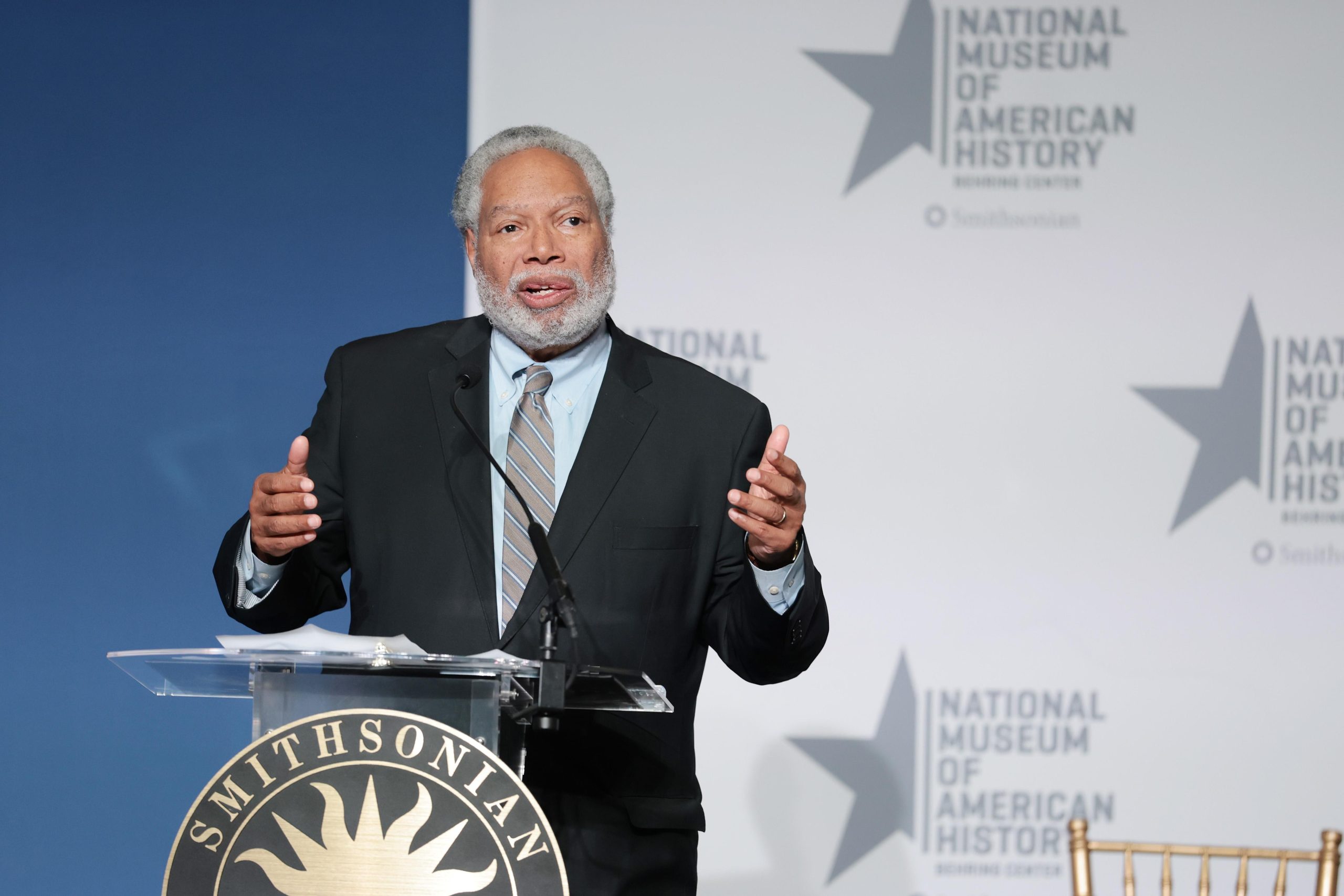
Lonnie Bunch, a bearded, white-haired man wearing a suit, gestures while speaking from behind a podium at an event at the Smithsonian National Museum of American History.

Secretary of the Smithsonian Institution Lonnie Bunch speaks during an event at the Smithsonian National Museum of American History on February 20, 2026, in Washington, DC. | Anna Moneymaker/Getty Images

This story appeared in The Logoff, a daily newsletter that helps you stay informed about the Trump administration without letting political news take over your life. Subscribe here.

Welcome to The Logoff: The head of the Smithsonian Institution will resign after weathering nearly two years of attacks by President Donald Trump. 

What’s happening? Lonnie G. Bunch III, the secretary of the Smithsonian, announced on Tuesday that he will step down at the end of 2026 after more than seven years in the role. 

Bunch’s retirement isn’t entirely about Trump; he’s 73 and has already served longer as secretary than his two most recent predecessors.

But the president, who has waged a relentless campaign against what the White House has described as “improper, divisive, or anti-American ideology” at the Smithsonian, is indisputably part of the story. As Bunch put it to the New York Times on Tuesday, “at a certain point, I’d like to wake up in the morning and not look at my cellphone.”

What has Trump done to the Smithsonian? Since last spring, Trump has gone after the Smithsonian system for promoting “narratives that portray American and Western values as inherently harmful and oppressive.” He has threatened its funding, forced out the director of the National Portrait Gallery, and attempted to meddle with its exhibits. His ability to successfully make changes has been limited by the Smithsonian’s structure — but a new secretary could give Trump far more control.

The president also, unsurprisingly, wants more Trump: administration officials have reportedly pressed for a new Portrait Gallery exhibit focusing on the president

What’s next? Trump doesn’t officially have a role in selecting Bunch’s successor, who will be chosen by the Smithsonian’s Board of Regents — but that board does include Vice President JD Vance and multiple Republican members of Congress, so he might as well.

Trump will surely want to install a loyalist, which means — as the Washington Post’s art and architecture critic Philip Kennicott explained on Tuesday — that the Smithsonian’s fate could depend on the ability of the rest of the board, and especially its chancellor, Supreme Court Chief Justice John Roberts, to resist.

And with that, it’s time to log off…

Don’t miss my colleague Rachel Cohen Booth’s new piece on the “smartphone trap”: the way in which phones have become not just ubiquitous, but required for many parts of daily life (reading a menu, parking a car, signing into an account — the list goes on). 

As Rachel argues, it’s not too late to preserve, or claw back, the option of going through life phone-free. “Pushing for a non-smartphone option is about accessibility, affordability, and agency. It’s about demanding the kind of freedom in a society we deserve to have,” she writes. 

You can read her full story here with a gift link — enjoy, and we’ll see you right back here tomorrow!

This post was originally published on this site

Posted on Leave a comment

Why Iowa is a state to watch in the midterms

Rob Sand, a clean-shaven man wearing a striped white shirt, shakes hands with a seated older man wearing green.

Democratic gubernatorial candidate Rob Sand greets members of the audience during a campaign visit to the Cass County Community Center in Cass, Iowa, on August 20, 2026. | Leon Neal/Getty Images

Can a love-thy-neighbor, stop-the-division campaign win over masses of rural voters? Rob Sand, the Democratic candidate for governor in Iowa, has his hopes pinned on it. 

Key to Sand’s campaign is a promise to end the red-blue warfare in politics. He’s made embracing independents and disgruntled Republicans a core part of his campaign, in addition to ending government corruption, holding big agriculture and big chemical companies responsible for the state’s high cancer rates, and addressing cost-of-living concerns. And his pragmatic approach seems to be working.

Polls have reliably shown Sand, who currently serves as Iowa state auditor, ahead of his Republican opponent, Zach Lahn — despite the GOP’s significant voter registration advantage. Democrats haven’t won the governor’s mansion in Iowa since 2006.

On top of the gubernatorial race, Iowa also has competitive Senate and House races, which could be key to Democrats’ hopes of gaining control of Congress during this November’s midterm election.

To break down what’s happening in Iowa, Today, Explained co-host Noel King spoke with Laura Belin, publisher and reporter for the Iowa political website Bleeding Heartland

Noel and Belin discussed Sand’s unique candidacy, whether it could have lessons for other Democrats looking to succeed in Midwestern states that have grown redder, and how President Donald Trump’s policies could be laying the groundwork for a rural backlash in this year’s midterm elections. 

Below is an excerpt of their conversation, edited for length and clarity. There’s much more in the full podcast, so listen to Today, Explained wherever you get podcasts, including Apple Podcasts, Pandora, and Spotify.

This midterm season, all eyes seem to be on Iowa. Why is Iowa so crucial?

What has happened in Iowa, where we used to be a swing state and we’ve moved into the red column, is not unique to Iowa. Every part of the country that looks like Iowa has seen the same trend of voters moving away from Democrats. It’s happened especially in these working-class communities where the electorate is predominantly white people without a college degree. 

Iowa as a whole voted for Barack Obama twice and then voted for Donald Trump three times. So if Democrats can figure out how to start winning again, or at least losing by less, in that kind of area, it could have implications not only for the future of Iowa, but for other states like Ohio, Michigan, Wisconsin, and Pennsylvania.

What are the main issues that people there are voting on and campaigns are campaigning on?

The high cost of everything is definitely the top issue. Democrats have really been hammering on the tariffs and the war in Iran, driving up the cost of everything. 

Also, healthcare costs have skyrocketed. 

We’ve seen healthcare access be an issue, because we’ve already seen some clinics close, and the companies that control those hospitals or clinics have talked about how it’s partly a reaction to the big Medicaid cuts that were passed in the [GOP’s 2025] budget reconciliation bill

According to many polls that I’ve seen, Trump is underwater in Iowa. His policies are not popular; the tariffs are not popular in Iowa. They’re widely understood to be hurting the Iowa economy. Anyone can see that the cost of everything has gone up.

So Trump is less popular this year. What are the Democrats doing to campaign on that? Are they running on Trump?

Most of the Democrats are not running directly against Trump. Rob Sand, the candidate for governor, hardly talks about Donald Trump at all. He really focuses on statewide issues. 

Josh Turek, the candidate for Senate, is running [on] the idea that [Republican Senate nominee] Rep. Ashley Hinson has just been a rubber stamp for policies that have hurt Iowa, whether that be the war in Iran [or] tariffs. It’s more running against the Republicans who have been a puppet [for Trump] rather than running against Donald Trump himself.

Let’s talk about that governor’s race and Rob Sand. This guy has gotten a fair bit of national interest. What do you know about him?

I’ve followed his career for a long time, since he was running for state auditor the first time in 2018. He’s been very visible. He’s gone out every year, done a hundred town halls a year, done them in every county. 

He is reaching out to independents because Iowa Republicans have a pretty large voter registration advantage. So he’s talked a lot about trying to empower independents more in our political spaces. He’s talked about getting Iowa back to divided government. He’s talked about how, with the large Republican majorities we have in the legislature, he would be a check on what they’ve done with 10 years of one-party rule.

He used to be a model. 

A long time ago, when he was in college. It’s funny, Republicans post these old modeling photos of Rob Sand from the ’90s and even [Sen.] Chuck Grassley’s campaign account posted some of those over the weekend.

And I always wonder — I mean, Republicans seem to think that they’re going to get traction out of that, but I don’t really see that as something that Iowans care about at all. I think a more common criticism that I hear is that Rob Sand has a very strong social media presence and has for years. In addition to making videos talking about political issues and what needs to be done in state government, he does a lot of things like reviewing pizza and donuts. 

They try to portray him as someone who’s not serious about his job. But I think that that’s just more [that] he has this goofy online persona. And I don’t really think it’s a detriment to his campaign.

Tell me more about the town halls. We’ve seen a certain type of Democrat emerge in the last few years and become very visible this campaign cycle: angry at the Democratic Party, angry at the direction of the country. 

Rob Sand — from what I’ve seen of him, it does not seem like anger is what he wants to tap into. Tell me what you’ve seen when he’s out in public.

No, he does not strike an angry note. And he’s not really part of this whole debate between progressives and moderates or centrists in the party. He’s really tried to chart, I would say, a completely different course of saying that he wants to get back to common-sense government, focusing on the issues that people can agree on. 

He’s talked about how if he’s governor and the legislature sends him culture war bills, we’re gonna have veto ceremonies instead of bill signing ceremonies. He doesn’t want to do any of this culture war thing. And one thing that he does at the beginning of every town hall is he asks people to raise their hands if they’re a registered Republican or a registered independent, and then he asks everybody to applaud for those people. 

He has everybody in the room sing the first verse of “America the Beautiful” together.

And he talks about how our politics has become so divisive. The way he frames it is that two private clubs, as he frames the major parties, he says, ‘They’re trying to make us hate people we used to love. And I’m sick of it. I’m sick of the division.’

Sometimes he asks for a show of hands: How many of you have had a family relationship or a longtime friendship disrupted over the last 10 years because of politics? There are always a lot of hands that go up. And he says, ‘I’m just sick of this.’ So he is running on trying to bring people together, but it’s not really in a kumbaya way, like we’re all going to agree on everything.

When he’s criticizing his Republican opponent, Zach Lahn — and one of his main talking points is that Zach Lahn doesn’t live full-time in Iowa, that he’s a part-time Iowan and spends a lot of time in Kansas — but before he even gets to that, he leads into it by saying, “There’s one thing that I want you to remember about my opponent that’s the most important thing. He’s a human being.”

The Democrats need a type of candidate who can win in red states. Rob Sand is interesting because it seems people have identified him as possibly that template. What do you think?

I don’t know how easy it would be to replicate Rob Sand. He grew up in a small town; he grew up hunting and fishing. He talks about his faith. I don’t know that everybody would be able to pull that off so naturally. 

But sometimes when people ask me, well, what happened to Iowa? It’s not anything specific to Iowa. It’s every part of the country that looks like Iowa has seen the same trend of Democrats losing ground. It’s the same reason Trump was able to win the states that used to be called the Blue Wall: Michigan, Wisconsin, and Pennsylvania. It’s the same reason Ohio has moved into the red state category. 

I think people are watching Iowa, especially Rob Sand and Josh Turek, the candidate for Senate, because if Democrats can find a way to turn things around in those types of areas — working-class communities that are predominantly white — there could be lessons that apply to other states.

This post was originally published on this site

Posted on Leave a comment

Justice Kavanaugh rejects Missouri’s request on GOP-friendly congressional map for midterms

Cropped msnow logo favicon.webp

Justice Brett Kavanaugh on Tuesday denied Missouri’s emergency request to use a GOP-friendly congressional map for the midterm elections.

The state’s request went to the Trump appointee because he is the justice assigned to handle urgent litigation from that part of the country. Justices can handle such applications themselves or refer them to the full court for resolution. Kavanaugh rejected Missouri’s application on his own, following his rejection last week of an emergency request for Michigan officials to put a measure on the November ballot over whether to require proof of citizenship to vote in that state.

As is typical for such orders, there was no explanation for Tuesday’s denial, though it suggests the justice found Missouri’s claim was weak.

The Republican-led state turned to Washington after Missouri’s Supreme Court blocked the map from being used in November. The state’s GOP-controlled legislature passed the map last year amid the nationwide gerrymandering push. Missouri’s Republican secretary of state, Denny Hoskins, sought to prevent a ballot measure in which voters would be able to decide whether to approve the map.

Hoskins reasoned that the referendum was invalid under the state’s constitution. But the state’s top court said Hoskins was incorrect about that. The court ordered him to put the measure on the November ballot, and it prohibited the state from using the new map unless and until voters approve it. Under the court’s ruling, the map passed in 2022 remained in full effect for November.

The state court noted that the referendum petition was submitted to Hoskins in December and that he didn’t announce his finding that it was insufficient until about an hour before a deadline last month.

Turning to the Supreme Court for speedy relief, Missouri said that a “federal-election-administration disaster is unfolding” due to what it called an unprecedented order from the state court.

“No court in American history has ever given such an extraordinary remedy, which inflicts unprecedented chaos on Missouri,” said the application from Republican Missouri Attorney General Catherine Hanaway’s office. It told the justices that “about 1.2 million Missourians” voted in the August primary under the new map and that the state Supreme Court “gave no specific guidance” about how to use the 2022 map for November.

Opposing the state’s application, referendum backer Richard von Glahn said that it “does not present a real emergency.” He said the state “waited as long as possible to manufacture the present dispute,” with Hoskins waiting “until the last possible day — and only after he had implemented HB 1 [the new map] in the congressional primary — to object to the referendum, in the hopes of running out the clock on the judiciary’s tolerance for a last-minute reversion to the 2022 districts.”

Von Glahn said the state court rejected Hoskins’ “gambit,” and he urged the justices to do the same. He said the secretary of state asked the justices “to deliver him the political victory to which he was never entitled under the Missouri Constitution.”

This is a developing story. Check back for updates.

Subscribe to the Deadline: Legal newsletter for expert analysis on the top legal stories of the week, including updates from the Supreme Court and developments in the Trump administration’s legal cases.

The post Justice Kavanaugh rejects Missouri’s request on GOP-friendly congressional map for midterms appeared first on MS NOW.

This post was originally published on this site

Posted on Leave a comment

Hunter Biden launches meme coin inspired by 2020 laptop scandal

Cropped msnow logo favicon.webp

Hunter Biden is about to take his trolling of his conservative critics to the blockchain.

The son of former President Joe Biden is debuting a meme coin Wednesday named after his infamous laptop, years after the device’s discovery dominated political headlines in the final stretch of the 2020 election.

Hunter Biden teased the launch of the coin, which will trade under the ticker “$LAPTOP,” by posting a video compilation Monday of conservative politicians and pundits, including President Donald Trump, talking about the computer.

The montage included a video of Trump referring to the device as the “laptop from hell,” a moniker that came to define years of attacks by Trump and his conservative allies against the Biden family.

Hunter Biden dropped off his MacBook Pro at a Delaware repair shop in April 2019, and the FBI later seized the device and an accompanying external hard drive. Communication that appeared to outline his foreign business dealings, explicit pictures of him doing illegal drugs in hotel rooms with women and swaths of his financial records were published by the New York Post three weeks before the election.

That led to a cascade of conservative conspiracy theories perpetuated by Trump over the Biden family’s overseas businesses, an influx of internet memes and a massive political headache for the Biden campaign.

The meme coin, which was first reported by The Wall Street Journal, takes a tongue-in-cheek jab at Trump’s own meme coin ventures. Trump launched $TRUMP shortly before his inauguration in January 2025 to capitalize on the crypto currency community that helped him win the 2024 presidential election.

But like almost any other digital token, which holds no real value outside of the notoriety of the figures who launch them, the coin surged before cratering: $TRUMP hit nearly $15 billion at its peak market capitalization before quickly plummeting as internet enthusiasm waned. Melania Trump’s meme coin, $MELANIA, has seen a similar fate.

One-fifth of the 1 billion tokens $LAPTOP plans to issue will go straight to the crypto wallets of the individuals who lost money on $TRUMP, according to the Journal. Others receiving $LAPTOP tokens include subscribers to Hunter Biden’s Substack and people on a mailing list curated by Andrew Callaghan, the host of the YouTube series Channel 5 and a personal friend of Hunter Biden’s. Some 30% will be retained by $LAPTOP’s founders, which include Hunter Biden.

Another 30% of the coin’s shares have been marked for destruction — which would boost the overall value of the coin — if a Democrat wins the 2028 presidential election or if $LAPTOP’s valuation exceeds $TRUMP’s, according to the Journal. The remainder will go to charity and the cost of launching the coin.

The launch of the coin has so far been met with mixed reaction from the cryptocurrency community. Callaghan distanced himself from the coin, saying he and his team have “nothing to do with” the venture and that they only provided their email subscriber list to help Hunter Biden expand his audience.

The post Hunter Biden launches meme coin inspired by 2020 laptop scandal appeared first on MS NOW.

This post was originally published on this site

Posted on Leave a comment

U.S. strikes Iranian tankers after more attempted missile attacks on Navy warship

Cropped msnow logo favicon.webp

WASHINGTON (AP) — The U.S. on Tuesday struck multiple Iranian tankers in response to more attempted missile attacks on a Navy warship, according to a U.S. official, who spoke on condition of anonymity to discuss sensitive military operations.

Iranian state television also is reporting that U.S. forces attacked Iranian oil tankers near the southern port of Jask and near Kharg Island in the Persian Gulf.

The latest tit-for-tat strikes come as Washington and Tehran lurch back toward fighting during more than six months of war.

An Iranian state TV reporter in Jask said an Iranian tanker was struck near the coast of Yekbeni, while another explosion was heard in the area whose source and location were not immediately clear.

State TV later reported that the U.S. military attacked a second tanker near waters off Jask. It said the crews of both vessels were being evacuated by lifeboat toward the Jask coast.

Separately, state television reported that another Iranian tanker was attacked in Kharg Island anchorage area. It said the crew was safely evacuated shortly after the strike.

Iran’s Revolutionary Guard Navy has warned crews of oil tankers near ports in Kuwait and Bahrain to immediately leave their vessels, saying the ships could be targeted in retaliation for U.S. attacks on Iranian tankers. It accused Kuwait and Bahrain of hosting U.S. forces and assisting in the attacks.

On Saturday, the U.S. military said it had struck three Iranian oil tankers after Navy warships were targeted with ballistic missiles, warning that it would, “if necessary, destroy Iran’s limited and exposed oil fleet.” Iran later said it planned to announce a new “exclusion zone” near the Strait of Hormuz aimed at vessels intending to transit.

The latest strikes are part of a dual economic and military approach by President Donald Trump as he struggles to bring an end to a more than six-month-old war with Tehran.

The Trump administration on Tuesday also imposed sanctions on additional elements of Iran’s aviation industry, targeting more than two dozen commercial and private airlines as well as foreign cargo service providers in its new push to isolate Tehran from its remaining trading partners.

Both the U.S. and Iran are seeking to exert control over the Strait of Hormuz, where about one-fifth of the world’s oil passed before the war began. Rising energy prices are posing political problems for Trump and his Republican Party ahead of the November midterm elections. A barrel of international standard Brent crude briefly climbed as high as $99.46 on Tuesday.

A U.S. blockade of Iranian ports has squeezed the country’s economy by limiting its oil exports, while the American military has been helping a limited number of ships transit on a route through the Strait of Hormuz off Oman. Tehran wants ships to follow a route that it chooses through the strait, which was considered an international waterway before the war.

The post U.S. strikes Iranian tankers after more attempted missile attacks on Navy warship appeared first on MS NOW.

This post was originally published on this site

Posted on Leave a comment

Tuesday’s Mini-Report, 9.8.26

Cropped msnow logo favicon.webp

Today’s edition of quick hits.

* Ottawa strikes back: “New Canadian tariffs targeting roughly $20 billion in U.S. imports officially snapped into place on Tuesday, the latest escalation in an increasingly costly trade war that has ensnarled two longtime allies. The duties apply to a variety of U.S. goods, including clothing, cheese, metal parts and wood products.”

* Evidently, the latest attempts at diplomacy did nothing to curb Moscow’s campaign of deadly violence: “Two people were killed and at least 10 injured after Russia struck the Ukrainian capital Kyiv with drones and missiles overnight on Tuesday, local authorities said. The attack comes after a pause over the weekend as U.S. envoys Jared Kushner and Steve Witkoff arrived in Kyiv for their first official visit in a renewed push to end the war between Russia and Ukraine.”

* German election results: “The far-right party Alternative for Germany fell short of an outright majority in crucial elections in the state of Saxony-Anhalt, according to final results posted on Monday. But it could still take power there if it wins the support of a minor populist party.”

* A huge loss for the Smithsonian: “Lonnie Bunch III announced his resignation as secretary of the Smithsonian Institution on Tuesday, marking the end of nearly four decades there amid pressure from the Trump administration to present a less critical version of American history.”

* That the U.S. delegation stood alone on this speaks volumes: “The United Nations has adopted a West African country’s proposal for a new world map to replace one created in the 16th century. The vote on Friday was almost unanimous. Only one country — the United States — voted against the proposed map, which more accurately reflects the size of Africa and other regions.”

* Some members of the worst Cabinet ever stand out: “Former Labor Secretary Lori Chavez-DeRemer violated department policy repeatedly, a report released on Thursday by the department’s internal watchdog said, including tolerating harassment, spending public money on personal travel and conducting an ‘inappropriate relationship’ with a member of her security detail. The 40-page report revealed new details of the dysfunction and toxicity at the top of the Labor Department under Ms. Chavez-DeRemer, who resigned in April after one year in the job as scandals and investigations closed in.”

* A story we’ve been following: “A federal judge in the nation’s capital declined to block the firings of journalists from military news outlet Stars and Stripes, in a case that the judge said required him to ‘confront the limits of First Amendment protections for public employees speaking about their jobs.’”

* Noted without comment: “Many MAGA-centered merchandise retailers and their suppliers are seeing sales dwindle, according to interviews with wholesalers, sales representatives, business owners and employees. As the president’s approval rating hovers near all-time lows, imperiling Republicans’ control of Congress, store owners blame a stagnant economy and weaker MAGA enthusiasm for lower sales. Some stores are closing permanently.”

See you tomorrow.

The post Tuesday’s Mini-Report, 9.8.26 appeared first on MS NOW.

This post was originally published on this site